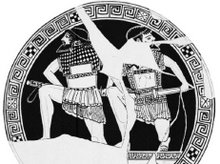
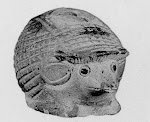
I received the OK from Jasper at Karawansaray Publishing to post my full article on hoplite mechanics as it appeared in the Marathon special issue of Ancient Warfare
: http://www.karwansaraypublishers.com/shop/the-battle-of-marathon-special.html
Over the last half
century, a schism developed over hoplite combat that has devolved into a bellum sacrum, with an orthodoxy assailed
by an increasingly popular heresy. The
orthodox position, championed by Hanson, Luginbill, and Schwartz, portrays
hoplites as lumbering masses of men that charged directly into each other and
contested the battlefield by attempting to physically push their foes. Van Wees, Krentz, and Goldsworthy, describe
hoplites as closer to skirmishers, fighting in an opened order, and often
paired with missile troops. Any “push”
was either a figurative description or uncoordinated shield-bashing. I believe they are both in some measure
correct, and often equally wrong, because this debate has forced historians to
stray far from their fields of study. Their
arguments suffer from an insufficient understanding of the physics and
mechanics of large masses or crowds. Group
behavior is my field, and, with the context that I can provide for their
arguments, I shall make an attempt at syncretism.
Herodotus, writing in
the mid 5th century, was the first author to describe the heavy
infantry of ancient Greece as hoplites, or men who were considered fully equipped
for battle. In his day, a hoplite’s arms
and armor, his panoply, might have included a bronze helmet, greaves, a bronze
cuirasse or corslet of leather or textile, and an iron sword. A rich man might add bronze thigh, upper arm,
ankle, and even toe guards. The only
pieces that seemed to have been required were the large, round shield or aspis and
a 1.8-2.5 m thrusting spear. Herodotus
contrasts hoplites with psiloi, literally “naked”, armed with missile
weapons. By the time Herodotus wrote, hoplites
fought in a formation termed a phalanx by modern authors, following Homer’s use
of the term in relation to massed combat.
The panoply of the
hoplite emerged in the late 8th century, with the advent of the
round, domed, shield and thrusting spear with pointed spear-butts, or
sauroters. It has been suggested that
these items indicate a break from earlier, skirmishing and missile combat, but
aspis bearing hoplites on some early vases, like the Chigi vase (ca. 640),
appear to bear a pair of spears with throwing cords attached, a shorter one
most likely to be thrown and a second longer spear which could be thrown or
used in close combat.
By the 5th century, the
classical Greek dory, or fighting spear, appears to have been as much as 2.5 m
long, but it was effectively longer because a combination of rear weighting and
tapering of the shaft moved the center of balance, hence the grip, back to
about a third of the way from the bottom. A 2.5 m dory had a reach of over 1.5 m,
similar to a 3.3 m mid-balanced spear.
The great reach of this spear was a handicap in single combat, because
it would be useless if a foe managed to move up shield to shield. A man cannot reach back far enough to bring a
point that is 1.5 m from his grip to bear with any force against a foe this
close. However, in a battle line, the
extra reach enabled hoplites to overlap their spears and support the men beside
them. Moving within the reach of the
combined spears of a phalanx would be much more difficult than evading any
single spear.
The shield has also
been seen as unsuitable for single combat.
The hoplite’s shield, the aspis, hoplon, or perhaps most specifically,
Argive aspis, varied little in size or shape over the whole period of hoplite
warfare. It was made in the form of a
flattened dome, some 10 cm deep, between 90 cm to just over a meter in
diameter, including a robust, offset rim of some 4-5 cm. The rim, and often the whole face of the
shield were covered in a single sheet of bronze, 0.5- 1 mm thick. The orthodoxy reconstructs this shield as
exceptionally heavy (7-9 kg), but Krentz has suggested a more likely 6.8 kg or
less.
These features are not
unique to the Greek shield. A convex
shape functions to transfer force away from the site of impact, while an offset
rim reinforces the face of the shield so that it does not split when
struck. Exceptionally convex shields,
conical in profile, are common in many cultures because the profile ensures
that an incoming strike will encounter a sloped shield-face.
The aspis had an
uncommon system of grips that some suggest limited the shield’s utility in
single combat to the point that men were forced to fight in close order. The left arm was slipped through a bronze
cuff, or porpax, placed either at the shield’s center or just to the right of
center. The porpax either accepted a
leather sleeve or was itself tapered to accept the forearm up to just below the
elbow, and fit like the cuff of a modern artificial limb, holding the limb so
snuggly that the shield would not rotate around the forearm. A second grip near the rim of the shield was
gripped by the hand, and tension from this grip acted to hold the arm in the
porpax. In shields from other cultures
that have a double-grip system, the grip for forearm and hand usually flank the
center of the shield. This allows most
of the shield to be brought up in front of its bearer, while the aspis allows
only half the shield to cover a man’s front.
The central placement of the porpax in the aspis is an advantage because
it makes holding the shield up on the bent forearm easier by reducing the
proportion of the shield’s mass that is to the right of the elbow and must be
pivoted up. A double-grip limits the
range through which a shield can be moved to block. The shield cannot be held as far away from
the body as one gripped by the hand, which leaves a greater portion of the body
vulnerable to incoming strikes and reduces the distance a strike must penetrate
to wound. It has been suggested that
hoplites could gain coverage by standing perpendicular to shields in a
“fencers” stance. This analogy is
untenable because fencers lead with their weapon hand, while hoplites would
have to come up parallel to their shields to effectively strike with their
spears.
The aspis has one
unique feature that is difficult to explain.
The Bomarzo shield in the Vatican’s Museo Gregoriano Etrusco, which
retains large portions of its wooden core, presents an odd picture. The shield’s core is only 5-6 mm thick over
much of the shield’s face, thickening to 8 mm in the center where the porpax
was affixed. Near the rim of the bowl,
the shield curves back sharply to form side-walls of 10-14 mm that taper
towards the shield face.
A shallow dome tends to
spread outward under pressure, and the wide, perpendicular rim acts to keep the
face from splitting. Under pressure, an
aspis will fail where the side-wall and the face join. This odd profile has inspired the suggestion
that the aspis’s great weight required this curve to allow a man to carry the
shield on his shoulder. Leaving aside
that the aspis’s mass has probably been overestimated, some rough calculations
show that this explanation is unlikely.
The aspis’s weight did not likely motivate the curved outer portion
because, even though only 3-4 cm wide,
the greater thickness and large diameter of the “ring” of wood that
makes up the side-wall section accounts for 20-40% of the total mass of wood
making up the shield-face! Reinforced
side-walls could provide added protection against chopping blows by swords, but
this would be superfluous given the thick, bronze covered rim. The side-walls appear to add more depth to
the shield than strength, a function we will return to later.
Modern authors present
us with irreconcilable images of how these early aspis-bearers fought. To some there was a “hoplite revolution” and orderly
phalanxes either closely follow or predate the new shield. Van Wees describes a “motley crew” of
intermingled hoplites, archers, and horsemen that slowly transitions from bands
of warriors to the phalanx familiar to 5th century historians. Tyrtaeus, a 7th century Spartan poet, wrote
to inspire the warriors of his polis.
Two themes run through his works: he chides his audience to stand close
to their fellows and to bring the fight to close quarters with their foes. Tyrtaeus can easily be interpreted as a
herald for the classical hoplite phalanx, with close ordered ranks and files. But if men were formed in an orderly phalanx,
why would the poet need to deride skulkers who remained out of the range of
missiles?
This dichotomy of
order-vs-chaos is a hot topic in the physical sciences, and the boundary
between the two has diminished. Order
within groups can arise spontaneously from seemingly random acts of individuals. We call this process self-organization. Through this mechanism, swarms, flocks, herds
and schools of animals achieve levels of coordinated movement that any human
drill master would envy. Swarms, or
crowds, of humans are capable of this type of organization as well. If we take van Wees’s “motley crew” and add
simple, logical rules like “archers tend to stand behind men with shields” and
“men with shields tend to stand beside men with shields to protect their flanks”,
then we end up with a formation that resembles the Germanic shield-wall or late
Roman foulkon. This type of formation
puts more heavily armored men, who may throw missiles themselves, in front of
unarmored missile troops to act as a wall or screen. Segregation like this is
natural in tribal war bands, where richer, better equipped men lead a troupe of
progressively poorer equipped warriors into battle. It would actually take more discipline to
keep troop types evenly mixed than to clump in this manner.
There is no need for
hoplites to form in a particularly opened order to allow men to move freely
through such a self-organized group. One
advantage of the large diameter of the aspis is that it acted as a literal
meter-stick. Men did not need to make
any judgment on their frontage beyond lining up shield rim to shield rim. In human crowds, as in schools of fish or
flocks of birds, individuals are completely interchangeable. The result is that
no one has a specific place in the formation and the group is highly
fluid. Men can move to the front line or
beyond to throw missiles at the enemy or challenge a foe, then melt back into
the group and retire out of combat. Such
“milling” is commonly seen in all but the densest of crowds.
When two crowds come
into contact, the dynamic changes and the presence of one lends order to the
other. The limitation on forward
movement and the presence of the enemy line as a focal point for the men in
both mobs results in the crowd becoming denser as men pile up. If the men at the front-line between the
groups are shield to shield, then the literal pushing of mass on mass
envisioned by the orthodoxy could ensue.
Thus, a crowd like this can be both flexible enough to allow all of the
missile combat and personal challenges seen in the pre-hoplite era and
spontaneously form into compressed masses akin to phalanxes upon contact with
the enemy. Men who are free to move
forward and back are also free to flee at the first setback. This can be mitigated by forming men up next
to their relatives or in smaller units, where leaving would be noticed. To form the ordered ranks and files that made
up the classical phalanx, each man needed to know only who he stood next to or
behind
If the economies of the
Greek cities allowed for increasing numbers of warriors and a higher percentage
of these were well armed hoplites, then a shift from a few ranks of men acting
to shield lighter troops to deep ranks of spearmen who charge swiftly to spear
range may simply emerge from the conditions of the battlefield rather than
result from an intentional tactical shift.
As the number of men increased, additional depth would be easier to
coordinate than a widely extended battle line. If the percentage of missile
troops dropped low, or the defenses of the hoplites reached a level of
protection that charging through an enemies’ missile barrage was less risky
than engaging in a missile duel, then the move to an all hoplite phalanx would
result. Once hoplites began to form in
more than four ranks, missile troops became ineffective. Xenophon (Anabasis 3.3.7) describes the
difficulty of bowmen in firing over the ranks of their own hoplites.
Increasing the depth of
phalanxes is advantageous in close combat for a variety of physical and
psychological reasons. The heretical
view holds that the ranks beyond the first one or two do not directly
participate in battle, but play an important role in supporting the front ranks
in battle. Beyond acting as a reserve,
ready to step forward over the fallen rankers in front of them, the mere
presence of these men behind the front rankers raises the morale of those men
fighting. In addition, deep ranks of men
formed behind the fighting front limit the ability of those men to turn and
run.
In orthodox view, all
of the ranks run together into battle as a single mass, then crash into the
formation of their foes. This physical
pushing match, for which the term othismos has been applied, has been likened to a giant rugby scrum, with
the goal of pushing the opposing section of the phalanx out of alignment with
the rest of the formation until they rout.
I believe that a pushing match did occur in hoplite battle, but I am
sympathetic to the heretics because the physics of othismos have been misstated
by the orthodoxy.
Othismos was a noun
that derived from the word otheo, a verb meaning “to thrust, push, or shove”. The modern definitions of othismos treat the
noun othismos as a verb, for example Liddell and Scott render it as either
“thrusting, pushing” or secondarily “jostling, struggling”. As a noun, the word would have to be defined
as “a state wherein thrusting, pushing, jostling or struggling occurs”. We commonly call such a state a dense
crowd. Perhaps the best English
equivalent would be the way we derive a state of dense crowding, a press, from
the verb “to press”. This is not a crowd
in the sense of many people or a throng, because the Greeks had other words to
describe that. It is essentially a
traffic term, like jam or deadlock, implying that many individuals are locked
together and cannot move past. Crowds
can “push” with extreme force, but the word focuses on density, more of a squeeze
directed within the group than without.
The term “Othismos” had
three common uses. First, it is used to
describe hoplite battle. Thucydides (4.96.2)
describes fierce combat, noting that it is accompanied by “othismos
aspedon”. This description has been held
up as the clearest evidence for othismos as “pushing with shields”, but perhaps
a better reading is a “deadlock of shields”, emphasizing the crowding of the
opposing ranks together, with or without pushing. Arrian (Tactica 12.3) used the same word to
describe not opposing ranks, but the crowding of second rankers in a phalanx
against the backs of the front rankers, after which they can reach the enemy
front rankers with their swords.
Second, othismos is used is in situations
familiar to anyone studying crowd disasters.
In the worst of these, people are asphyxiated or squeezed either hard
enough or long enough to cause them to lose consciousness or die because
pressure on their chest and diaphragm prevents them from breathing. Xenophon (A. 5.2.17), Plutarch (Brutus 18.1),
and Appian (Mithridatic wars 10.71) all describe othismos occurring as a crowd
of men attempt to exit a gate. Polybius
(4.58.9) describes the Aegiratans routing the Aetolians who fled into a city:
“in the confusion that followed the fugitives trampled each other to death at
the gates…Archidamus was killed in the struggle and crush at the gates. Of the
main body of Aetolians, some were trampled to death…” It is a maxim that most deaths attributed to
trampling are in fact due to asphyxia while still standing.
The third use of
othismos occurs where literal pushing could not occur. When Plutarch (Aristides 9.2) describes ships
in othismos, he refers to crowding, not mass pushing. In many cases, “othismos” is completely
figurative. Herodotus twice (8.78, 9.26)
uses othismos to describe an argument. This
is often translated as a “fierce argument”, but traffic terms are commonly used
to describe arguments. For example, we
regularly call for an arbiter when two sides in negotiation come to an impasse
or a log jam. At Plataea, the Tegeans
and Athenians (Herodotus 9.26) found themselves at an impasse in negotiations
because they both put forth equal claims to an honored place in the army’s
formation.
The definition of
othismos does not of itself require a coordinated push of all ranks against an
enemy formation, but I believe there was such a concerted struggle of mass
against mass. The orthodoxy portrays
hoplites as charging as much as 50 m in order to impart what Schwartz termed “a
maximum of penetration power at the collision”.
However, the whole notion that hoplites charged like un-horsed medieval
knights to maximize the mass’s force during a collision is a fallacy. It takes only a few yards to achieve “ramming
speed”, and any excess distance causes fatigue and loss of cohesion. They would
be correct if the goal was to maximize the force of one man colliding with
another, but the physics of maximizing the aggregate force of a group of
individuals is different. Dense packing
is far more important to transfer a strong, sustainable force, even if it
occurs at slow speed. If a hoplite
phalanx charged directly into a pushing of match, it would have closed up all
of the men in the files belly to back in the manner I have previously described
(Bardunias 2007) and charge from very short range to minimize the loss of
cohesion.
The common description
of othismos as a tug-o-war in reverse leads to some false impressions. The image conjures up men standing
perpendicular to their foes, digging in the edge of their rear foot as they
lean into the man in front with their shoulders in the bowls of their
shields. But in a tug-o-war, the force is
transferred through the rope and men can take any stance as long as they pull
on the rope. This is not the case with
files of men pushing. As men in files
pushed against those in front, the force first acted to compress the men in
front, and only after they resisted compression could force be transmitted
ahead. At moderate levels of compression
this was not a problem, but as greater force was transferred forward, the men
could no longer hold their shields away from their bodies and shields became
pressed to the torsos.
If men were standing in
a side-on stance as portrayed by the orthodoxy, the force would be transferred
directly through the shoulders of each man in file. This was unstable because the only thing
holding men perpendicular to their shields was the strength of their left arm. Unless the men closed up laterally belly to
back, which is impossible with a meter-wide aspis, the sustained, grinding
pressure on their right shoulders would force them to collapse forward until
they were parallel to their shields and the men in files were packed belly to
back. Once they achieve this spacing and
stance, they can be compressed no further and have achieved what specialists on
crowd disasters term a “critical density”.
This is defined as at least 8 people pressed together with less than 1.5
m of spacing per person. By simply leaning against the man in front like a line
of dominoes, 30-75 % of body mass can be conveyed forward in files, and just
three leaning men can produce a force of over 792 N or 80 kg. Shock waves can travel through such crowds,
and less than 10 people have been shown to generate over 4500 N or 450 kg of
force.
This has been misunderstood
by authors in the past. To counter the
objection that the force transferred forward by men in files would be lethal to
one’s own file-mates, Franz, as quoted by Schwartz, mistakenly put forth that
force is not derived from the weight of them men in file, but from their
muscular strength in pushing. This is
not true. He further quotes Franz as
describing why the files did not produce lethal pressure: “When people behind
sense that pushing does not produce an immediate advantage, they stop
pushing. This results in a kind of
reverse thrust.” This is surely true for
most historical armies, where weapon play, not pushing is the goal, but the
whole point of othismos as defined by the orthodoxy is to push against the
opposite formation with the greatest force.
A file of hoplites, even 8 deep, could produce enough force to kill a
man through asphyxia. A force of 6227 N
will kill if applied for only 15 seconds, while 4-6 minutes of exposure to 1112
N is sufficient to cause asphyxia.
Hoplites would be purposefully attempting to create and maintain levels
of pressure that occur accidentally in crowds.
Killing crowds form when people try to move in a specific direction,
such as towards a stage or out a door.
Hoplites pushed ahead in file, and if whatever was in front of them did
not give way, pressure would rapidly build to lethal levels, and by simply
leaning forward they could maintain much of this force for extended periods.
There is no requirement for containment such as walls alongside the crowds as
we usually see in disasters. As long as
they are pushing towards a common goal, in this case directly toward the enemy
through the back of the man in front, they will not disperse laterally.
The heretics would be
correct in assuming that pushing by deep files was not survivable, but for one
detail. In my description of the hoplite
shield, I put off discussing the single feature of its construction that
appears to be unique - the oddly thickened side-walls. As I noted, it appears to primarily add
depth, not strength, when compared to other convex shields. It is this depth that allows a man to survive
the press of othismos, by protecting his torso from compression. To do so, it would be held directly in front
of the body with the top right half of the shield resting on the hoplite’s
upper chest and the front of his left shoulder, the bottom on his left thigh. Most of the men in files would have been standing
upright and leaning forward. Only the
rear few ranks had enough freedom of movement to assume positions that are
compatible with active pushing. Shock
waves of the combined weight of the file would be added to the pushing force in
the rear rankers in the same manner that the mass of a battering ram is pushed
towards a barrier.
Othismos may have originated
because men pushed their foes away from fallen leaders to retrieve their corpses
and armor. Such struggles are common in
the Iliad, and Herodotus used the word othismos to describe the struggle over
Leonidas’s body at Thermopylae (7.225).
In what may represent an egalitarian shift, victory in hoplite battles
generally went to the force that held the battlefield and the bodies of all the
fallen men upon it. This could represent a ritualization of warfare, and a
means of deciding conflict that minimized slaughter, but it may have been the
most efficient means of combat given a preexisting warrior ethos that called
large decisive battles and the retrieval casualties. Pushing would have evolved gradually from
close-in fighting that predated the aspis.
Mass pushing is not unseen in other settings. For example, the Romans pushed with bosses of
their shields Zama (Livy), but the shape of the scutum limited the maximum
force that could be generated without killing their own men. A sub-lethal, jostling, shoving crowd must
have existed before the aspis became specialized for killing crowds. Also, the threat of battle moving to a lethal
crowd phase would justify the shape of the shield, even if othismos was not the
goal of combat. The shield as “life
preserver” in a killing crowd explains the constancy of the shape over time. The deep, flattened dome could not vary much
and still retain its ability to resist compression. When the shield was found inadequate
protection from missiles, an apron of leather was hung from the round shield
rather than remaking the shield into a weaker oval that would provide the same
coverage.
The remainder of this
article describes the course of hoplite battle in Herodotus’s day, reconciling
orthodox and heretical views where possible.
Athenian hoplites, like those of most poleis, called up amateur levies
according to tribal units called taxeis of about 700-1000 men, which was then
subdivided into lochoi of 100 or more. The
men may have not had set places in ranks, but by this date they probably knew
who they stood next to. These taxeis
were drawn up alongside one another to form what Thucydides called a parataxeis
and others call a phalanx. Spartans provide us with an example of what was
possible with a professional army. Their
basic tactical unit was the sworn band or enomotia of about 40 men, wherein
each man knew his assigned place.
Ancient authors usually recorded the number of ranks, or shields, men
formed in. This seems to have often been
up to the unit commander, and could commonly vary from 4 to 16, with 8 or 12 being
the norm for most of the period.
Environmental constraints, like a narrow road, could force units to form
in deep ranks by stacking smaller units.
Thebans in the late 5th and early 4th century notoriously formed in 25
or even 50 ranks for major battles, an obvious advantage for their contingent,
but their allies attempted to limit them to 16 ranks in the Corinthian war
because the sacrifice in frontage left the whole phalanx vulnerable to
envelopment.
Once the men were in
place, in most armies their leaders would walk along the front haranguing
them. Spartans relied on encouragement
between hoplites and sang to each other in the ranks. In a prelude to the battle to come, the
opposing light troops or cavalry could skirmish in the space between the
opposing phalanxes. When the light
troops had been recalled and the sacrifices had been taken, the commanders had
trumpets, salpinx, sounded and men began marching towards the enemy. At this distance men would have been marching
with their spears on their right shoulder and their shields on their left. For comfortable carry, the balance point of
the spear should be just beyond the shoulder, and many images show hoplites
holding the spear down near the sauroter.
Ancient Greek battle fields were notoriously flat and not overly broad
which allowed men to keep some semblance of order. As they advanced the hoplites sang the Paian
in unison, aiding morale and coordination.
Marching in step would have been beyond most armies, but Spartans moved
to the sound of pipes to help the men keep pace. At this point men would bring the shield up
in front and the command would be passed for the first two ranks to lower
spears. This has been interpreted as
bringing the spears down to an underarm position, but hoplite reenactors have
discovered a simple maneuver to “lower” a dory into the overhand position. They let the spear fall forward off the
shoulder while at the same time bringing the rear of the spear out and up. There would be no need to shift the grip
later if overhand strikes are desired.
When the armies were
less than 180 m apart, most phalanxes shouted an ululating war cry to Enyalius
and charged at the run. They did so for
psychological reasons, both to channel their nervous tension into the attack,
and frighten the enemy with their rapid advance. Coordinating the charge along the chain of
units that made up the phalanx seems to have been difficult, and gaps often
formed as some hoplites charged sooner than others. Variation in speed of advance could lead to
one section of the line leaving the rest running to catch up (Xenophon,
Anabasis, 1.8.18). Spartans did not
charge at the run, but approached in a slow, orderly fashion, so any unit
ranged alongside them invariably pulled away when they charged. The result is that a phalanx rarely
encountered its opposite as a unified front.
For these reasons Thucydides (5.70.1) tells us that large armies break
their order are apt to do in the moment of engaging.
Thucydides (5.71.1)
also describes phalanxes drifting to the right as they advanced because men
sought to shelter their unshielded right side. This would have resulted from
men twisting their torsos to hold the aspis in front of them. But it is likely that the whole phalanx
contracted as well. Bunching as they
moved would have been a natural reaction of frightened men as it is with other
animals. The Strategikon, attributed to
Maurice (12B.17), describes the ease with which men can converge laterally just
prior to contact with the enemy. Two
approaching phalanxes would end up overlapping on the right through either
drift or contraction to the right, and the difference would be difficult to
tell. Men who began the charge at a
spacing of just over the diameter of their shields might now find that they
overlap to some degree with their neighbor’s.
Much of the order lost
during the charge could be regained as units reformed a battle line upon
contact with the enemy. The alternative
is that whole taxeis ran tens of meters past units next to them in line that
were engaged when the foes opposite were delayed or slow moving Spartans. The two phalanxes would have slowed as the
enemy loomed large. The same fear that
drove them to charge would keep them from running blindly into a hedge of enemy
spears. Because disorganized men charging at speed into the enemy results in a
weaker mass collision, there is no reason why men could not halt at spear range
rather than after crashing together. If
men did not regularly stop and fight with their spears, then it is difficult to
understand the many references to one phalanx breaking when the two had closed
to spear range. Hoplites converging at
even a modest 5 mph would cover this distance in less than half a second.
What followed was
described by Sophocles (Antigone, 670) as a “storm of spears”. While taunting their foes, the first two
ranks of the opposing phalanxes would assume the ¾ stance common to most combat
arts and strike overhand across a gap of about the 1.5 m reach of a dory. The overhand motion results in a much
stronger thrust than stabbing underhand (Connolly, 2001), and would be less
likely to impale the men behind. When
striking from behind a wall of shields, the overhand strike not only ensured
that your arm was always above the line of shields but allowed a wide range of
targets. During this combat adjacent
hoplites were mutually supporting, and a man could be killed through the
failure of those alongside him (Euripides, Heracles 190). The second rankers would have attacked where
they could reach, but their spears also acted to defend the men in front.
The aspis would have
been tilted up and toward the enemy.
With the shield snug on the forearm, this would be the natural result of
lifting the arm, but it also presents the maximum shield area to a downward,
overhand strike. In this position, the
shoulder doesn’t bear any of the weight because the centrally placed porpax
results in the lower half of the shield balancing the upper half with all the
weight on the arm. It can be braced
against the shoulder if pushed back by a strike.
Spear fighting could go
on for some time, and often one side must have given way as a result, but we
know that battles could move to close range.
It is difficult to imagine men easily forcing their way through multiple
ranks of massed spears, but we know that hoplites often broke their spears, and
a sword armed man would be highly motivated to close within the reach of his
foe’s spear. Perhaps this was easier as
fatigue set in. Once swordsmen closed
with the spearmen somewhere along the line, phalanxes could collapse into each
other like a zipper closing as spearmen abandoned their useless spears in favor
of their own swords.
It is now that rear
rankers could bring their pressure to bear.
They would close up swiftly, initially supporting those in front, but then
gradually pushing them tight together.
All ranks would now cover their chests with their shields. While this was occurring the front rankers
fought, and their blows could not miss (Xenophon, Anabasis, 2.1.16). Images of hoplites show a variety of strikes
that could be used with the upraised right arm over the shields. The so-called “Harmodios blow” is a high
slash from around the head that has been derided as useless, but here strikes
and parries up around the head would be the rule. Point heavy chopping swords would be useful
in othismos, but the short swords, often attributed to Sparta and seen on
stelai from Athens and Boeotia, would be deadly. A downward stab, alongside the neck, into the
chest cavity can be seen on a vase in the Museo Nazionale de Spina (T1039A).
The crowding of
othismos and periods of active, intense pushing could last for a long time as
men leaned ahead like weary wrestlers.
But the peak pressure is only maintained if the opposing phalanx chooses
to resist it. If they move back, their
foes have to pack-in tight again before maximum force can be transferred. All such moves have to start at the back of
the files, there is no point at which a man could simply jump back and his
enemy would fall forward. Just as
packing was gradual, so is unpacking.
The whole mass would move in spasms and waves like an earthworm. Increased file depth is an advantage in this
type of contest, but the answer to those who wonder how why at Leuktra 50 ranks
of Thebans didn’t immediately drive 12 ranks of Spartans from the field rests
in the difficulty in coordinating such deep files of men to push in unison and
the need to constantly repack as men advance.
Deep ranks function more like a wall behind those in front than an aid
is pushing forwards.
When hoplites could no
longer sustain the rigors of pushing, the rear ranks of the phalanx would turn
and flee. What followed could be a free
for all as men broke ranks to target the backs of routed foes. It is now that lessons of hoplomachoi,
martial arts masters, were of most use (Plato, Laches 182a). Men who had been holding up their arms
throughout battle would surely opt for underhand strikes at this point as seen
for single combat on many vases.
Hoplites did not press pursuit for long, so many saved their lives by
dropping their shields and spears and outpacing those chasing them. Safer still was making a stand with
compatriots and letting the victorious hoplites find easier prey as Socrates
did after Delium (Plato Symposium 221b).
Hoplite battle
encompassed both the storm of spears and press of shields, but by the late 5th
century clever generals were coming up with ways of exploiting the weaknesses
of both phases of combat. Envelopments
and ultra-deep formations took advantage of the weaknesses of armies set on
simply fighting a decisive battle with units arrayed opposite them, often with
little regard for flank protection. A
century later hoplites would lose their supremacy to Macedonian pikemen,
themselves up-armored skirmishers, who presented them with spears that far outranged
the dory and only a dense hedge of spear points to push against.
Paul Bardunias is an
entomologist working on self-organized group behavior in termites and
ants. His interest in ancient warfare is
hereditary, for his family comes from Sparta.
He is currently applying his scientific training to provide new insights
into hoplite combat at www.hollow-lakedaimon.blogspot.com. He is indebted to Russian hooligans, whose
tireless shenanigans allow us to witness the fluidity and spontaneous order
that arises in crowds of belligerent men (http://www.youtube.com/watch?v=dAk4dceoK4&feature=related).
J.K. Anderson, Military
theory and practice in the age of Xenophon.
Berkeley and Los Angeles 1970
P. Bardunias, ‘The aspis. Surviving Hoplite Battle’, in: Ancient Warfare I.3 (2007), 11-14.
G.L. Cawkwell, ‘Orthodoxy and Hoplites’, in The Classical Quarterly 39 (1989),
375-389.
P. Connolly, D. Sim, and
C. Watson, “An Evaluation of the Effectiveness of Three Methods of Spear Grip
Used In Antiquity”, in: Journal of
Battlefield Technology, Vol. 4, No. 2, July 2001.
A.K. Goldsworthy, ‘The Othismos, Myths and Heresies: The Nature of Hoplite Battle’, in War and History 4 (1997), 1-26.
V.D. Hanson, The
Western Way of War. Oxford 1989.
V.D. Hanson (ed.), Hoplites. The Classical Greek Battle Experience. London and New
York 1991.
P. Krentz, ‘The Nature of Hoplite Battle’, in: Classical Antiquity 16 (1985), 50-61.
P. Krentz, ‘Continuing the othismos on the
othismos’, in Ancient History Bulletin
8 (1994), 45-9.
P. Krentz, D. Kagan and D.
Showalter, The Battle of Marathon.
Yale University Press (2010).
R.D. Luginbill, ‘Othismos:
the importance of the mass-shove in hoplite warfare’, in: Phoenix 48 (1994), 51-61.
L. B. Perkins, Crowd
Safety and Survival, Lulu.com, 2005
A. Schwartz, Reinstating
the Hoplite: Arm, Armor, and Phalanx Fighting in Archaic and Classical Greece.
Franz Steiner Verlag, 2010
H. van Wees, Greek
Warfare. Myths and Realities. London 2004.