I made a video for some of the new guys going to Plataiai back in 2022 on the basics of spear fighting. It is rough, but I thought I would share it here.
Friday, February 23, 2024


The Face of Battle at Plataiai

On the field of Plataiai 2022
I am linking to an article I wrote with Roel Konijnedijk which summarizes most of the thoughts on the transition of hoplite tactics between the Archaic and classical period.
Konijnendijk, Roel / Bardunias, Paul M. (2022) “The Face of Battle at Plataiai.” In Andreas Konecny and Nicholas Sekunda (eds.), The Battle of Plataiai, 479 BC (Phoibos Verlag: Vienna, 2022) pp. 211-242 https://www.academia.edu/77994737/The_Face_of_Battle_at_Plataiai
Monday, December 19, 2022
The Clash of Shield-walls at Plataea
I have not posted on here for a long time, but I have not been idle. Last spring I gave a lecture at the 2022 Battle of Plataea conference at Harvard's Center for Hellenic studies on the hoplite combat and the clash of Greek and Persian shield-walls.
https://youtu.be/Sjypd4iSTnw?si=mqDHRATiNipMcQy0
Thursday, July 12, 2018
The Linothorax
The Linothorax

The ancient
Greeks knew that armor could be made of linen, woven from fibers of the flax
plant, (Linum usittatisimum L.). Anyone
at recitation of Homer’s Iliad would have heard Ajax the Lesser described with
the term “linothorex”, thus “linen cuirassed” (Il.2.529). The current debate centers on whether or not
we can apply the term “linothorax” to a specific type of armor that is widely seen
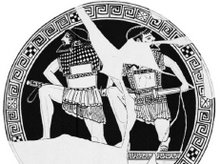
depicted on vase imagery and in sculpture. The earliest depictions of hoplites
show them to be armored in bronze plate, but 6th century BC saw the
emergence of a new type of corselet that was probably constructed of organic
materials given the lack of archaeological evidence. Woven linen and leather
have been suggested for the base material, but there is no agreement as to
which is more likely. I will present
arguments for and against each, and hope to foster a consensus.
This armor was used from Skythia to
North Africa, and remained in use alongside the plate cuirass throughout the
Classical and Hellenistic periods. Almost
all of the details of its construction are garnered from vase images, many of
which are quite detailed, with archaeological finds limited to metal fittings
and a single rendering of the type done in iron from a late 4th
century Macedonian royal tomb at Vergina.
The armor consisted of two main
portions. The torso was protected by a
“tube” or “box” that wrapped around the body, was scalloped to fit under the
arms, and had a raised panel to cover the upper chest. Many of these corslets show broad bands
across the upper chest and midsection decorated with a key pattern or similar
design. Just above the hips, the bottom
of the tube was cut into strips, pteryges, which facilitated bending,
while covering the lower abdomen. Usually
there was a double layer of pteryges, which were staggered so that the inner
layer filled gaps created in the outer layer as the hoplite moved.
Most images show hoplites fastening
the tube by means of thongs tied at the left, front to form a cylinder, perhaps
because the left side of a hoplite was covered by his large shield. There seems to have been variation in exactly
how the tube section was brought together.
The side panel may have simply been butted to the front panel and
secured, but the single extant copy of the armor from Vergina is double
breasted, overlapping the chest region from both directions. Other images, like that on a vase from the
Museo Etrusco Gregoriano (inv. 16583), show a tab with no pteryges of about a quarter the width of the chest panel wrapping
around in front. This would serve to
cover the seam where the sections meet.

Affixed to
the upper back of the tube, or perhaps cut from the same piece of material, was
a panel that protected the shoulders.
Two flaps, epomides, arose from this and extended over the
shoulders like a “yoke” to be tied down to the chest panel. The epomides were generally long and
broad, especially in the early period, extending well down the chest and flaring
out laterally from along side the neck to just before or beyond the
shoulders. There manner in which the
flaps were tied down could be complex, with thongs simply attaching to lateral
rings, crossing the chest to secure on opposite sides, meeting in the center,
or apparently passing through lateral and central attachment points. One advantage of this system was to allow the
epomides to be secured and tensioned independently. For a hoplite this was important because he
spent much of his time with his arm raised for overhand strikes with the
spear. If weight were distributed evenly
between the shoulder flaps when the arms are lowered, then it would have been
disproportionally borne on the right shoulder as the arm was raised. Another aid in the overhand strike was that
the thongs on the epomides emerge close to their inner edge. Thus, when
the arm was lifted, the shoulder flaps naturally hinge up on their inner
edge. Between the two shoulder flaps a
square section arose to stand up behind the back of the neck.
Because the term linothorax implies
a mode of construction, I will use a term for the armor based on the morphology
just described instead of material: the “Tube and Yoke” (T-Y) corslet. It is difficult to determine when this armor
type first appeared in the Greek world.
Hoplites wore only a simple tunic or chitoniskos beneath their
cuirasses, so there was nothing like an arming doublet that could have
developed into an organic armor. There
also was no armor with these characteristic seen outside of Greece
In close combat a hoplite could
shelter most of body behind his shield, but his head and often his shoulders
would go uncovered as he fought. Attacks
coming from above might glance off the helmet onto the shoulders or impact them
directly. When battles came to pushing, othismos,
the broad, flat surface of the flap as it lies over the left front chest
provided a perfect surface to rest the bottom of the shield rim against. Interestingly, while the broad epomides
seen on some vases overlapping the shoulder would have allowed the inner rim of
the bowl-shaped shield to rest upon them when marching, pushing with the
shoulder in this position would force the flap into the hoplite’s neck.
 |
Hoplites donning their armor
|
Many cultures had armors made of
textile or leather, and quilted armor existed in Greece during the Mycenaean
period. These armors usually look like a
vest or jacket. One reason for the T-Y’s
shape would be that the material from which it was constructed was particularly
stiff. Much has been made of images that
show epomides springing back to stand straight up when unsecured, but
the need to cut pteryges into the bottom of the tube to allow for
freedom of movement when bending also indicates stiffness. These corslets are shown holding their form when
not being worn, as on a vase at Zurich University (L5). The apparent stiffness of the corslet has
meant that any material that cannot be rendered this stiff has been rejected as
a base for the armor.
The form of the T-Y corslet has a
major advantage over vest-cut armor that pulls over the head. Hoplites could quickly undo the thongs tying
the armor together to allow for air flow.
Anyone who has worn body armor or sports pads, such as football shoulder
pads, knows that simply unfastening them in this manner cools the body
greatly. There are vase images that show
hoplites in a characteristic state of undress, with the tube unfastened and
hanging opened on the left side and the shoulder flap on the opposite side
undone.
 |
| Me in my spolas of leather in an at ease position with the weight suspended from only the left shoulder. |
They are usually portrayed as white
on black-ware vases of the latter 6th c BC. Usually, white was reserved for organic
components, such as the flesh tone of female figures, sword hilts, and chitons
that were probably textile. Some of
these chitons extended to mid-thigh and show a crosshatched pattern that
might show quilting, perhaps indicating that these were a light armor in their
own right. Early T-Ys show very broad epomides, often meeting in the
middle of the chest. By the end of the 4th
c BC, the epomides are move to the side of the chest and are generally
reduced in length and width. Perhaps
this reflects a move away from hoplite tactics.
The corslet also becomes higher waisted and one or two additional tiers
of pteryges are added extending down the thighs. Pteryges are sometimes seen at the
shoulders as well, perhaps to make up for the epomides reduction in
size.
Adding metal scales, bronze, rawhide, or iron, was a common feature of these armors. The variation in shape, number and placement on the armor is staggering. So much so that I would caution trying to draw too many conclusions, such as how weapons were used, based on scale placement. But this article shall focus mainly on the base material. I will note that it is unclear that scales add protection rather than add flexibility for the same level of protection.

Linen
The first reference to linen armor
that is truly relevant to the T-Y corslet comes from the poet Alcaeus, born to
an aristocratic family from Mytilene on Lesbos around 620 BC. In a poem of the early 6th c, he
describes arms and armor, probably hanging in a temple. There are obvious hoplite accoutrements, such
as bronze greaves and hollow shields, but among these he writes of “White corslets
of new linen” (fr. V 140). He and his older brother Antimenidas served
as mercenaries for the Egyptians and Babylonians respectively. Hoplite mercenaries serving abroad may have
brought home new types of armor, or ideas for making armor from new materials.
Herodotus describes a number of
linen corselets in foreign use. He tells
us that Amasis, King of Egypt, sent “Thorakes
lineoi” to the temple of Athena at Lindos (Hdt. 2.182) and Sparta
Xenophon also describes another
Anatolian people of his own day, the Chalybians, as wearing line “thorakes” with “a thick fringe of
plaited cords instead of pteryges” (Xen. Anab. 4.7.15). This is a
reference to the T-Y corselet based on the pteryges, but we must be
cautious in reading too much into the reference. He does not clearly state that the Greek corslets
are linen as well, only of similar form.
There is a somewhat muddled
reference to linen armor in Xenophon’s day that is often cited in support of
the T-Y being a textile armor. Cornelius
Nepos, in his life of Iphicrates, mentions that among the other military reform
the general enacted was switch from “linked or brazen” to linen armor (Nep.
Iph. 1.4). Not only is his mention of
mail armor anachronistic, but this change in armor is missing from our other main
source for his reforms (Dio. Sic. 15.44). More troubling, and seemingly overlooked by
proponents of linen being commonly used during the Classical period, this shift
was described as a reform, a new addition to the panoply, and so not a common
item.
Probably the most reliable evidence
for the use of linen armor in the 4th century comes from Aeneas Tacticus
written about 350 BC. In describing how
weapons in one instance were smuggled into a city, he lists among the armor
brought in “Thorakes lineoi” (Aen.
Tactic. 29.1-4). We shall return to this reference later.
When Alexander the Great was
reinforced in Asia by allied and mercenary
troops, they also brought along new suits of armor for his men, so he burnt his
men’s old armor, which must have been organic (Curtius 9.3.21). He himself wore a linen armor we are told at
the battle of Guagamela: “a breastplate of two-ply linen from the spoils taken
at Issus ” (Plut Alex. 32.5). This of course is very likely of Persian make
and so may not inform us on the other organic armors worn by Macedonians.
Pausanias relates a note of caution
on the use of linen armor. He tells us
that “Linen breastplates are not so useful to fighters, for they let the iron
pass through, if the blow be a violent one. They aid hunters, however, for the
teeth of lions or leopards break off in them.” (Paus. 1.21.7).
One problem
with linen as a base for armor is that it is notoriously expensive to grow. Both Virgil (Georgics1.91) and Pliny (HN
19.2.7) remarked on the fact that flax seriously depletes the soil, so Greeks with
limited tillable land probably imported most of their high quality linen. Egypt Syria Colchis
were famed for their linen. Strabo
(11.2.17) tells us that linen export was used as a basis by some in the
assumption of kinship between Colchis and Egypt
Linen fiber
quality is tied to length, with short fibers known as tow and limited in their
uses. Linen is inelastic and presents a
challenge to the weaver in forcing one thread over another if they are thick
and a dense weave is desired. The
solution to this problem can be seen in a pseudomorph, a mold formed during
decay, of an Etruscan textile at Newark
Museum , NJ , USA

We have seen that a candidate
material needs to be stiff, light in color, and show broad flat panels or
rounded surfaces. Many cultures made
textile armor by stitching many layers of fabric together or stuffing padding
between two shells to form a thick quilted structure. Objections to this type of construction
include the fact that we generally do not see stitching patterns on vase
portrayals of the armor and some have doubted the stiffness of stitched or
quilted fabric. To the first objection,
it must be noted that some vase images do show cross-hatched patterns or
vertical lines that may best be explained as quilting. The Pompeian “Alexander Mosaic” of the battle
of Issos shows many of the retreating Persians in what looks very much like
quilted armor. Recall that Alexander was
said to have taken a 2 ply linen armor in this battle, and two layers, filled
with batting could be effective protection.
The stiffness of stitched linen is
governed by how close the rows of stitched can be made and the number of layers
of fabric used. Dan Howard, has
championed a style of close stitching that renders stiff panels as seen today
on the flaring shoulder protection used in the Japanese sport of Kendo. Such close stitching might not be prominent
enough to have been rendered by artists.
An ingenious solution to the
problem of making stiff, flat linen panels was suggested by Peter
Connolly. Instead of stitching layers of
linen together, he glued them together in 0.5 cm thick panels. The resultant armor weighed 3.6 kg, which is
less than a bronze cuirass of similar size.
Following his suggestion, many have constructed T-Y corselets of linen
and glue. The product is stiff and hard,
but vulnerable to moisture, sweat being the biggest threat. Once soggy it becomes gummy and gains weight
as it absorbs water, so a waterproof layer of resin, lanolin, olive or linseed
oil, or beeswax is needed.
Glued linen construction seems to
have become the default for the T-Y.
This is troubling, because there is no archeological data or
pre-existing industry on which to base glued construction. Analogies must be drawn from far different
applications, such as the lamination of wood or exotic procedures like the
wrapping of Egyptian mummies in gummed linen bands. In the end the argument boils down to that
fact they could have made glued linen given the technology of the day and it
seems to provide adequate protection.
Recently, a group at the University
of Wisconsin, Green Bay, headed by Greg Aldrete and Scott Bartell have tested a
variety of linen armors, both quilted and glued of between 11 and 20 layers. Using authentic hand woven linen and either
rabbit or flaxseed glue, they found glued linen to be superior in protectiveness
to quilted or stitched linen against period appropriate weaponry. These findings are counter to what others
have found in the past, and problems with reproducibility in tests such as this
will ensure debate. As a scientist, my
advice to those attempting such tests is that it is far more important to work
off of a standard protocol than it is to use authentic weaponry. Luckily textile body armor is back in vogue,
so we can tailor future tests to protocols such as that of the National
Institute of Justice (NIJ).
Leather
We have
previously seen that Xenophon was familiar with a thorax made of linen, but he
never describes his fellow Greeks as wearing them. Instead he uses a specific term when
describing items which appear to be armor, but are not bronze cuirasses. On the long retreat back to Greece Persia
Although there are exceptions, generally when a wound is
described as occurring through a piece of equipment it is because it was
expected to protect from such attack.
Xenophon described the death of the Laconian Leonymus when an arrow
pierced both his shield and his spolados (Xen.Anab.4.1.18).
Julius Pollux, a late 2nd
century AD professor of rhetoric at Athens tells us that the “spolas is a thorax of leather, hanging from the shoulders, so that Xenophon
says ‘and the spolas instead of thorax’” (Onomast. 7.70). This
definition is corroborated by Hesychius of Alexandria, 5th century
AD, who apparently drew from an independent source. He wrote of the spolas that is was a “short leather chiton, the leather thorax.” The words used for the leather associated
with the thorax are different, but in both instances are associated with
animal hide. Pollux uses a term that
could also be used to describe a lion skin wrapped around a hero or the facing
of a shield (Hom. Il. 10.23, 6.117), while the word Hesychius uses implies
rawhide such as that of the drumhead described by Euripides (E.Ba.513). Perhaps the yoke section of the T-Y originated
as a separate piece like a hide hung from the shoulders. Pollux goes on to say that “Sophocles called
it a Libyan: a Libyan spolas, a leopard skin.” Leopard skins can be seen on vase depictions
worn like an exomis, or short cloak, hanging from the left
shoulder. Short length, hide or leather
construction, and suspension from the shoulders may be the defining
characteristics of the spolas. These
are also clearly characters of the T-Y corselet.
There is another mention of the
word spolas in the latter 5th
century. This occurs in a comedy by Aristophanes
(Aristoph. Birds. 933), where a priest’s acolyte is asked to remove his spolada
and give it another. Here it is unclear
what the garment is, but it is something worn over his tunic, and a leather apron,
such as workmen wear or a frontlet to protect from the blood of sacrificed
animals is a possibility that fits with the other definitions.
As well as mentioning leather
armor, what Xenophon doesn’t mention may be just as important. In two separate works he describes Ephesus
The ancient Greeks imported much of
their leather from The Cyrenaic and Pontic regions, but cities like Athens had
thriving tanning industries. The general
and demagogue Cleon was lampooned by Aristophanes based on the smells
associated with the tanneries that Made Cleon’s father rich. Cleon was a notorious warmonger, and profiteering,
perhaps in armor, may have influenced his politics.
Leather can easily form broad flat
surfaces, but as to stiffness, we must consider what type of leather is to be
used. Vegetable tanned leather, which
relies on the use of tannins from bark, nut hulls, or other vegetable matter,
produces fine leather than will not putrefy in water. Its resilience recommends it for a wide variety
of clothing applications, but a single layer of tanned ox hide will not produce
the stiffness seen in the T-Y without further processing. It can be rendered hard enough to hold a
molded form by boiling it in water, oil or wax.
The result is stiff, but brittle.
A second method would be to simply laminate multiple layers of leather
together. Unlike linen, leather will
stick to itself via its own collagen, but casein, from milk, in an alkaline
solvent is commonly used as well.
A tanned hide might not be pale
enough to warrant it being illustrated in white. Buff leather, tanned in oil, alum tawed leather,
and rawhide might be pale enough for this.
Alum tawed leather in particular is vivid white and can be either very
stiff like rawhide or creamy soft depending on the processing, but like rawhide
it is unstable and vulnerable to moisture.
Perhaps the most likely candidate is a combination of processes. Buff or vegetable tanned leather could be
treated with alum in order to produce a stiff, white product.
I previously presented only part of
a passage by Aeneas Tacticus on smuggling weapons into a city, the expanded list
of items reads: “Thorakes lineoi, Stolidia, perikephalaia, hopla,
knemides….” (Aen. Tactic. 29.1-4). The first item is of course linen
corslets, but the second is leather corslets!
Aeneas is describing both types of T-Y in use concurrently. This is not the only instance of their joint
appearance. Both leather and linen
armors can be found side by side in the records of a temple treasury on
Delos. Ruben Post pointed me to a series
of redundant fragments of inventory lists from 342-340 BC (ID 104(26, 28, 29) include version of
the line “Thorakia
skutinous...Linou...spoladion.” The
first item is leather thorakes and
the second is fragmented but lists something that is linen and may well
describe a stoladion, confounding all
of our terminology. If leather construction does not define the spolas, then it may have been used
interchangeably with thorax. Alternately, these two words may refer, not
to different material, but to a different construction.
Clearly the term “linothorax” is inappropriate for the T-Y corslet, or
at least incomplete. There is every
possibility that a single corslet could be of composite linen and leather
construction, perhaps linen tube and leather yoke. Either we must agree on a term that is purely
based on morphology, not material, like “tube and yoke corslet,” or we must add
some variant of spolas/stolidion or
“skutinothorax” to indicate those armors that are made of leather.
Added notes:
Gleba has proposed that warp-twined linen
greave found at Dura Europos may be a model for the tube and yoke as well.[1] She notes that twining of many yarns would
explain Pliny the Elder’s comment that a thorax dedicated by Amasis had an
exceptional thread-count of 360.[2] Certainly, a breastplate that Alexander acquired
from the spoils taken at Issus and composed of “two-ply linens” could only have been made of so few layers if they
were exceptionally robust.
These thick layers need not have been glued or stitched together. They may in fact have been woven in multiple layers in a process known as 3-D weaving.

Nymphopdorous says that the armor is called
aegis by the Spartans Hesychius Lexicogr., Lexicon (Α—Ο). Aegis is a term which
refers to a leather hide of a goat.
We cannot really say that either leather or linen armor is in the form of the T-Y even if it existed. We have many examples of heavy tunic or vest-like garments on vases that may have been "armor":
 |
| This looks very much like a "Tube" without epomides and with tassles in place of ptyruges. |
 |
| A heavy garment, probably linen. similar in thickness to the perizoma sometimes worn as a skirt under bronze cuirasses. |
 |
This is clearly a leopard skin in a vest-cut garment.
|
Wine, Vinegar and salt
Pliny: CHAP. XLVIII.Divers kinds of wooll and clothes.Moreover, wool of it selfe driven togither into a felt without spinning or weaving, serveth to make garments with: and if vinegre be used in the working therof, such felts are of good proofe to bere off the edge and point of the sword; yea and more than that, they will checke the force of the fire.
Niketas Choniates, Byzantine (1140-1213) "He fought them then without a shield, and in lieu of a coat of mail he wore a woven linen fabric that had been steeped in a strong brine of wine and folded many times. So hard and compact had it become from the salt and wine that it was impervious to all missiles, the folds of the woven stuff numbered more than eighteen."
Kaolin
From Hoplites at War:
Aelian uses an enigmatic term argilos, meaning ‘white clay’, to
describe an armor appropriate for light troops.[1] Some have translated this as a bright white
tunic, while others have taken him to have meant ‘flashy’; however, it could
well be that he literally white-colored clay.
A type of fine white clay, known to as kaolin, was widely used by the
ancient Greeks. It was a white pottery
glaze, and a slip of kaolin formed the drawing surface on white oil jars
(lekythoi), which became popular in early the 5th century. Theophrastus of Eresos, on Lesbos ,
in his late 4th century treatise On
Stones described possible kaolins as Melian and Samian earths. They were commonly used in fulling and
bleaching textiles.
We are benefited in our study of
ancient armor that textile body armor has come back into fashion. A recent study showed that the ability of
Kevlar armor to defeat spike and knife threats can be significantly increased
if kaolin is intercalated into the weave.
The clay stiffens through a process called “shear-thickening”, wherein
the clay-coated fibers are pliable if slowly pushed against, but resist sliding
past each other at speed and when impacted at high velocity. This sees the clay particles form an atomic
lattice that for the briefest moment is hard as ceramic.[2] Reinforcement with kaolin has an advantage
over other techniques proposed to make textile tube and yoke corselets in that
such clay was often a component of the bleaching process of linen
garments. A clear evolution of the armor
from incompletely rinsed white linen is thus easy to envision. The tube and yoke became popular at Athens
[2] Rosen et al. 2007. Shear-thickening
can be seen by stabbing forcefully into a dilatant like oobleck, which is a
thick slurry of corn starch.
Further reading
No better
discussion on the topic can be found than that on http://www.romanarmytalk.com I wish to
thank all of the contributors to the discussions there whose opinions are to be
found in this article.
Bardunias, P. and Rey, F. (2016) Hoplites at War.
Connolly, P. (1984), Greece and
Rome at war, Greenhill books
Anderson, J.K. (1970), Military
theory and practice in the age of Xenophon, University of California Press.
Williams, A. (2003), The knight and
the blast furnace: a history of the metallurgy of armour in the Middle Ages
& the early modern period. Volume 12 of History of warfare. Brill.
http://www.comitatus.net/
Wednesday, November 30, 2016
A reddit thread that I wound up posting quite a bit on.
I saw this blog mentioned on a reddit thread, so I jumped in to add my two cents. Fans of this blog will find the discussion interesting. I put forth many of the arguments you will find in "Hoplites at War".
https://www.reddit.com/r/AskHistorians/comments/4na0mj/how_good_is_christopher_matthews_scholarship/?st=iw5kjrxe&sh=31473f4e
https://www.reddit.com/r/AskHistorians/comments/4na0mj/how_good_is_christopher_matthews_scholarship/?st=iw5kjrxe&sh=31473f4e
Wednesday, September 14, 2016
Hoplites at War
My book Hoplites at War with Fred Ray will be coming out this fall.

http://www.mcfarlandbooks.com/book-2.php?id=978-1-4766-6602-0
I have held off on posting anything that would wide up in the book, but now that it is on the way I will be uploading a series of videos here and on this blog's sister Facebook site and YouTube channel:
https://www.facebook.com/groups/206586183088885/
https://www.youtube.com/channel/UC8uaDxWxD_MmN3TeEcdc5IA
http://www.mcfarlandbooks.com/book-2.php?id=978-1-4766-6602-0
I have held off on posting anything that would wide up in the book, but now that it is on the way I will be uploading a series of videos here and on this blog's sister Facebook site and YouTube channel:
https://www.facebook.com/groups/206586183088885/
https://www.youtube.com/channel/UC8uaDxWxD_MmN3TeEcdc5IA
Tuesday, March 24, 2015
A simple pendulum for testing the strike force of spears.
There is a renewed interest in testing the type of spear strikes that hoplites used in battle. Much of this is done with more enthusiasm than science, but enthusiasm goes a long way. I thought I should post images of a very simple apparatus for accurately testing strike force.
The simplest means of testing strike force is to hit a pendulum. If you can hang something heavy, like a barrel, from four anchor points, then you will have a reproducible means of showing strike force. The four-point anchors cause the pendulum to move back in a more or less linear fashion. If you film how far the pendulum moves you have a metric for force.
Since my wife would kill me if I drilled lots of holes in my roof, I have created an easy type of pendulum that does not require gravity to push against. It costs about $20 and takes a half hour to build with simple tools.

This pendulum makes use of springs to provide resistance to a 2x4 on a hinge. Note the rod on the side that goes through an eye-bolt and the round disk of plastic. This will give you a relative measure of strike force. Note that in my first attempt, I put the hinge too close to the springs. Better to move it back a bit and extend the springs with cable.

When your spear strike knocks it back, the disk gets pushed back and remains in place.

You could simply measure the distance the disk moved and use that as a relative measure for comparison between types of strikes. If you want a more scientific measure that can be compared between different people, get a scale, like a fishing scale, and hook it at about the height where your strikes hit and pull the board back until it reaches the point where the disk is. This gives you a quantitative measure in pounds or kg for the force needed to knock the board back that far.
If you can't hit a 2x4 with your dory...practice. But you could add a larger target.
The simplest means of testing strike force is to hit a pendulum. If you can hang something heavy, like a barrel, from four anchor points, then you will have a reproducible means of showing strike force. The four-point anchors cause the pendulum to move back in a more or less linear fashion. If you film how far the pendulum moves you have a metric for force.
Since my wife would kill me if I drilled lots of holes in my roof, I have created an easy type of pendulum that does not require gravity to push against. It costs about $20 and takes a half hour to build with simple tools.
This pendulum makes use of springs to provide resistance to a 2x4 on a hinge. Note the rod on the side that goes through an eye-bolt and the round disk of plastic. This will give you a relative measure of strike force. Note that in my first attempt, I put the hinge too close to the springs. Better to move it back a bit and extend the springs with cable.
When your spear strike knocks it back, the disk gets pushed back and remains in place.
You could simply measure the distance the disk moved and use that as a relative measure for comparison between types of strikes. If you want a more scientific measure that can be compared between different people, get a scale, like a fishing scale, and hook it at about the height where your strikes hit and pull the board back until it reaches the point where the disk is. This gives you a quantitative measure in pounds or kg for the force needed to knock the board back that far.
If you can't hit a 2x4 with your dory...practice. But you could add a larger target.
Monday, October 6, 2014
Christopher Mathew's flawed analysis of the mechanics of hoplite combat: 1
I find myself having to dispel some of the new myths put forth by Chris Mathew's analysis of the mechanics of hoplite combat that formed his Ph.D. thesis and was first presented in the article:
http://www.amazon.co.uk/Storm-Spears-Understanding-Hoplite-Action/dp/1848842953
There are serious flaws with his analysis and even more with his presentation. He contacted me early on in his studies, and in the interest of full disclosure I must tell that myself and few others attempted to steer him away from the mistaken path he was on.
I have been largely away from Ancient Greek topics for over a year now due to other demands on my time, but now that I have come back I am finding far too many online discussions where his portrayal of hoplite combat has taken root. I am loathe to enter into what must be a deconstruction of his thesis because he is a dedicated reenactor of ancient hoplites. For years I have been suggesting that he is exactly the type of researcher that those writing histories of Greek combat must heed. Reenactment can be, when done well, experimental archaeology. When it is it must conform to the ethics of a scientific experiment and honestly assess alternate views. In this Mathew's work fails. I assume these are honest mistakes, scientists make them all the time, but the bias he brings to his analysis is all too glaring in his presentation.
When his book came out, the general consensus I received from the many hoplite reenactors I correspond with was that the analysis in Storm of Spears was flawed based on their experience and his notions failed to convince the hoplites at the Marathon gathering. I had hoped that by now members of these other groups would have shot down the mistaken ideas, but I see now that perhaps they do not have the reach to disseminate their ideas as efficiently as Mathew does. I am not sure that I do either, but I will give it a try.
Before I step into the debate, here is an assessment of Mathew's use of percentages of vase depictions as evidence for the exclusive use of an Underhand grip for the hoplite spear. The author is my friend Fred Ray, who has written some really interesting books on hoplite battle. If you are reading this blog, then you should give them a look:
http://www.amazon.com/Land-Battles-5th-Century-Greece/dp/0786467738/ref=sr_1_1?ie=UTF8&qid=1412604879&sr=8-1&keywords=Land+Battles+in+5th+Century+B.C.+Greece
http://www.amazon.com/Greek-Macedonian-Land-Battles-Century/dp/0786469730/ref=sr_1_2?ie=UTF8&qid=1412604879&sr=8-2&keywords=Land+Battles+in+5th+Century+B.C.+Greece
I will note that I have no financial tie to these books, but I did give some advice on certain topics.
Here is Fred's review that her was kind enough to share with us on Hollow Lakedaimon:
When Push Comes to Shove: What Was the "Othismos" of Hoplite Combat?
Historia: Zeitschrift für Alte Geschichte
Bd. 58, H. 4 (2009), pp. 395-415
Published by: Franz Steiner Verlag
Article Stable URL: http://www.jstor.org/stable/25598486
Bd. 58, H. 4 (2009), pp. 395-415
Published by: Franz Steiner Verlag
Article Stable URL: http://www.jstor.org/stable/25598486
10.2307/25598486
And later in the book Storm of Spears:
There are serious flaws with his analysis and even more with his presentation. He contacted me early on in his studies, and in the interest of full disclosure I must tell that myself and few others attempted to steer him away from the mistaken path he was on.
I have been largely away from Ancient Greek topics for over a year now due to other demands on my time, but now that I have come back I am finding far too many online discussions where his portrayal of hoplite combat has taken root. I am loathe to enter into what must be a deconstruction of his thesis because he is a dedicated reenactor of ancient hoplites. For years I have been suggesting that he is exactly the type of researcher that those writing histories of Greek combat must heed. Reenactment can be, when done well, experimental archaeology. When it is it must conform to the ethics of a scientific experiment and honestly assess alternate views. In this Mathew's work fails. I assume these are honest mistakes, scientists make them all the time, but the bias he brings to his analysis is all too glaring in his presentation.
When his book came out, the general consensus I received from the many hoplite reenactors I correspond with was that the analysis in Storm of Spears was flawed based on their experience and his notions failed to convince the hoplites at the Marathon gathering. I had hoped that by now members of these other groups would have shot down the mistaken ideas, but I see now that perhaps they do not have the reach to disseminate their ideas as efficiently as Mathew does. I am not sure that I do either, but I will give it a try.
Before I step into the debate, here is an assessment of Mathew's use of percentages of vase depictions as evidence for the exclusive use of an Underhand grip for the hoplite spear. The author is my friend Fred Ray, who has written some really interesting books on hoplite battle. If you are reading this blog, then you should give them a look:
http://www.amazon.com/Land-Battles-5th-Century-Greece/dp/0786467738/ref=sr_1_1?ie=UTF8&qid=1412604879&sr=8-1&keywords=Land+Battles+in+5th+Century+B.C.+Greece
http://www.amazon.com/Greek-Macedonian-Land-Battles-Century/dp/0786469730/ref=sr_1_2?ie=UTF8&qid=1412604879&sr=8-2&keywords=Land+Battles+in+5th+Century+B.C.+Greece
I will note that I have no financial tie to these books, but I did give some advice on certain topics.
Here is Fred's review that her was kind enough to share with us on Hollow Lakedaimon:
Storm of Spears (2012, Pen & Sword Military) by C. Matthew:
Some Observations Regarding the Analysis of Artistic Images
Matthew’s analysis of
artistic portrayals in support of his core theory that hoplites within
classical phalanxes did not normally engage in shock combat using over-arm
strikes with their primary weapon (the thrusting spear) appears to be
fundamentally flawed. One can readily accept his contention (p. 20) that
a majority of the figures evaluated (an estimated 243 [71%] out of a sample of
340 in which the grip could be determined) show a weapon with a centrally
located point of balance. One can also easily buy the assertion (p.
21-23) that these devices are much more suitable for throwing than the sort of
thrusting spears designed for shock combat that were common to classical
phalanx battle. These latter favored a rearward grip (p. 8-11).
Such ideas find further backing from the information cited on length in
which the data sub-set of weapons held overhead (and dominated by central
grips) has a notably shorter average (p. 23-24). This is consistent with
devices that can be thrown effectively and contrasts with longer averages for
sub-sets dominated by weapons having rearward grips and therefore better suited
to thrusting (p. 14). The observation offered that sauroters best
associated with simple thrusting spears (p. 4-5) are more common on images of
longer/rear-grip weapons (p. 22) also backs this argument. Matthew’s
proposal (p. 31-33) that a majority of the images in the artistic record
portray archaic or mythological figures using weapons other than single-purpose
thrusting spears thus appears sound. However, while this bodes well for
his contentions (p. 23, 38) that past evaluations treating these weapons solely
as thrusting spears are likely in error, it does not lend support to his linked
assertion (p. 38) that essentially all fighting with the thrusting spear
used under-arm methods. Indeed, the image data presented actually appear
to disprove that particular concept.
Accepting that an apparent 243 (86% of the 60% fraction held over-arm plus half
of the 40% fraction held under-arm [p. 16]) among useable images involve
center-grip weapons other than those traditionally employed in classical era
shock action, only analysis of the remaining 97 figures (those with rearward
grips indicative of a single-purpose thrusting spear) are relevant to the
frequency of hand-to-hand techniques used by classical Greek spearmen. Of
these, 29 (30%) display an over-arm grip while 68 (70%) show an under-arm
grip. Given that an over-arm grip would have no real value outside of its
possible employment in shock combat, every image showing that approach with a
simple thrusting spear (unsuitable as a missile) must therefore have been meant
to portray a man engaging in (or preparing to engage in) shock fighting.
But figures displaying an under-arm grip could well be doing something else -
advancing while putting minimal stress on the spear-arm or resting that arm
during a lull in battle for example. This meshes with Matthew’s
simulation data (p. 122-125) that shows an under-arm pose to be less tiring
during combat. Also agreeing, if we discount the possibility (though it
is strong in my opinion) that the antique, center-grip weapons might be
dual-purpose spears useful for shock combat and are instead solely missile
weapons, is that those 68 figures holding center-grip weapons under-arm (28% of
the center-grip total) must be resting their throwing-arm in a similar
fashion. This means that we can count only those figures with an
under-arm grip that are also shown in the very midst of a shock fight as
truly secure examples of under-arm thrusting. Unfortunately, we are given
no value for this (or a table of rawer information from which it might be
derived).
As a result, given only
the image data provided by Matthew, one must conclude that an over-arm
technique for shock combat appears at least 30% of the time (that value being
the case should all of the images with under-arm grips describe ongoing
shock actions). And this could rise to as high as 100% (in the highly
unlikely case that none of the under-arm images show ongoing shock
actions). Therefore, with a technically possible 30-100% range for its
portrayal, the over-arm method for spear-fighting appears to find rather
convincing support within the artistic record as presented by Matthews, instead
of being completely ruled out as he asserts.
If we reject for
argument’s sake that some (or all) of the center-grip weapons in the images are
multi-purpose spears and assume them to all be missile weapons (“javelins” per
Matthew’s terminology), then we might use them as an analog for a more
refined guess at the likely percentage of over-head thrusting on display.
There are 243 images with mid-shaft grips and 68 (28%) of them are under-arm
poses not suitable for missile combat (where one could not throw the weapon in
hand). This suggests that only 175 (72%) of these images truly represent
men actively engaging at the instant shown. If the same ratio is applied
to figures with thrusting spears (rear-grip weapons), we can calculate that 41
among those shown in under-arm poses are also engaging in shock action.
(This adds that under-arm fraction to the 29 in over-arm stances suitable
for nothing but shock combat to reproduce the 72% share of combat stances in
the center-grip analog.) This would mean that there are 29 figures (40%
of the rear-grip total) making over-arm strikes and 41 (60%) striking under-arm
(interestingly, a mere inversion of the 60/40 ratio in favor of over-arm use
cited by some in considering that all images were showing shock combat
poses). Of course, before taking this kind of estimate “to the bank,” one
must again remember that it excludes all consideration of dual-purpose spears
being on display. Also, it must be viewed in the context that of the 480
figures initially studied by Matthew, only 340 (71%) provided useful
data. These were then reduced to 97 (20%) potentially relevant to the
specific question under review and only 70 (just 15% of the original total)
could then be applied to the investigation’s bottom line when all was said and
done. As such, even rather modest biasing of the sample pool by the
forces of chance in rendering 140 (a full 29%) of the original 480 figures
useless (precisely twice the number available for the final calculation) could
well have had quite a significant impact on the conclusions reached.)
We should further consider that even the foregoing rather more “over-arm
friendly” view of the artistic record might underestimate the frequency of that
method’s true employment. This is because very few (if any) of the
studied images are likely to be portraying the “othismos” stage of phalanx
combat in the “literal” (i.e. physical) sense. Here, hoplites would have
been pressed “belly-to-back” in a manner unsuited for the side-on views
commonly employed in ancient artworks. And an over-arm utilization of the
thrusting spear might well be the most practical method during othismos.
There is wide acceptance that such literal othismos is explicitly referenced in
several of our most detailed descriptions of phalanx battles (per Matthew’s
note on p. 237). And though Matthew considers it rare on the basis of
these being few in number, it remains likely (in my opinion) that similar
episodes of literal othismos developed in a much higher count of more poorly
documented actions featuring similar tactical dynamics.
- Fred
Ray
Friday, June 20, 2014
My other history related articles
This was the original presentation of the crowd-othismos. As you can see in the last article this concept has matured.
'The Aspis: Surviving
Hoplite Battle'. Illustrated by Johnny Shumate: http://www.karwansaraypublishers.com/cms/karwansaray/ancient-warfare/about/readmore-aw/13-ancient-warfare/ancient-warfare-issues/31-ancient-warfare-i-3.html
‘Don’t get stuck on
glued linen’: http://www.karwansaraypublishers.com/cms/karwansaray/ancient-warfare/about/readmore-aw/13-ancient-warfare/ancient-warfare-issues/49-ancient-warfare-iv-3.html
'Regulus' demise'. Illustrated by
Carlos de la Rocha and Igor Dzis.
The fate of nations is often decided on battlefields and the
course of battles may be decided before they are fought by the tactical genius
of great generals. History's foremost military commanders led their people to
conquest or fought to stave off being conquered. They fought as usurpers or
championed freedom and spread ideologies. Rarely in history have leaders
altered the course of history solely for that purest of motives: profit.
Xanthippus of Sparta was one such man.
The Storm of Spears and Press of Shields
I received the OK from Jasper at Karawansaray Publishing to post my full article on hoplite mechanics as it appeared in the Marathon special issue of Ancient Warfare: http://www.karwansaraypublishers.com/shop/the-battle-of-marathon-special.html
Over the last half
century, a schism developed over hoplite combat that has devolved into a bellum sacrum, with an orthodoxy assailed
by an increasingly popular heresy. The
orthodox position, championed by Hanson, Luginbill, and Schwartz, portrays
hoplites as lumbering masses of men that charged directly into each other and
contested the battlefield by attempting to physically push their foes. Van Wees, Krentz, and Goldsworthy, describe
hoplites as closer to skirmishers, fighting in an opened order, and often
paired with missile troops. Any “push”
was either a figurative description or uncoordinated shield-bashing. I believe they are both in some measure
correct, and often equally wrong, because this debate has forced historians to
stray far from their fields of study. Their
arguments suffer from an insufficient understanding of the physics and
mechanics of large masses or crowds. Group
behavior is my field, and, with the context that I can provide for their
arguments, I shall make an attempt at syncretism.
Herodotus, writing in
the mid 5th century, was the first author to describe the heavy
infantry of ancient Greece as hoplites, or men who were considered fully equipped
for battle. In his day, a hoplite’s arms
and armor, his panoply, might have included a bronze helmet, greaves, a bronze
cuirasse or corslet of leather or textile, and an iron sword. A rich man might add bronze thigh, upper arm,
ankle, and even toe guards. The only
pieces that seemed to have been required were the large, round shield or aspis and
a 1.8-2.5 m thrusting spear. Herodotus
contrasts hoplites with psiloi, literally “naked”, armed with missile
weapons. By the time Herodotus wrote, hoplites
fought in a formation termed a phalanx by modern authors, following Homer’s use
of the term in relation to massed combat.
The panoply of the
hoplite emerged in the late 8th century, with the advent of the
round, domed, shield and thrusting spear with pointed spear-butts, or
sauroters. It has been suggested that
these items indicate a break from earlier, skirmishing and missile combat, but
aspis bearing hoplites on some early vases, like the Chigi vase (ca. 640),
appear to bear a pair of spears with throwing cords attached, a shorter one
most likely to be thrown and a second longer spear which could be thrown or
used in close combat.
By the 5th century, the
classical Greek dory, or fighting spear, appears to have been as much as 2.5 m
long, but it was effectively longer because a combination of rear weighting and
tapering of the shaft moved the center of balance, hence the grip, back to
about a third of the way from the bottom. A 2.5 m dory had a reach of over 1.5 m,
similar to a 3.3 m mid-balanced spear.
The great reach of this spear was a handicap in single combat, because
it would be useless if a foe managed to move up shield to shield. A man cannot reach back far enough to bring a
point that is 1.5 m from his grip to bear with any force against a foe this
close. However, in a battle line, the
extra reach enabled hoplites to overlap their spears and support the men beside
them. Moving within the reach of the
combined spears of a phalanx would be much more difficult than evading any
single spear.
The shield has also
been seen as unsuitable for single combat.
The hoplite’s shield, the aspis, hoplon, or perhaps most specifically,
Argive aspis, varied little in size or shape over the whole period of hoplite
warfare. It was made in the form of a
flattened dome, some 10 cm deep, between 90 cm to just over a meter in
diameter, including a robust, offset rim of some 4-5 cm. The rim, and often the whole face of the
shield were covered in a single sheet of bronze, 0.5- 1 mm thick. The orthodoxy reconstructs this shield as
exceptionally heavy (7-9 kg), but Krentz has suggested a more likely 6.8 kg or
less.
These features are not
unique to the Greek shield. A convex
shape functions to transfer force away from the site of impact, while an offset
rim reinforces the face of the shield so that it does not split when
struck. Exceptionally convex shields,
conical in profile, are common in many cultures because the profile ensures
that an incoming strike will encounter a sloped shield-face.
The aspis had an
uncommon system of grips that some suggest limited the shield’s utility in
single combat to the point that men were forced to fight in close order. The left arm was slipped through a bronze
cuff, or porpax, placed either at the shield’s center or just to the right of
center. The porpax either accepted a
leather sleeve or was itself tapered to accept the forearm up to just below the
elbow, and fit like the cuff of a modern artificial limb, holding the limb so
snuggly that the shield would not rotate around the forearm. A second grip near the rim of the shield was
gripped by the hand, and tension from this grip acted to hold the arm in the
porpax. In shields from other cultures
that have a double-grip system, the grip for forearm and hand usually flank the
center of the shield. This allows most
of the shield to be brought up in front of its bearer, while the aspis allows
only half the shield to cover a man’s front.
The central placement of the porpax in the aspis is an advantage because
it makes holding the shield up on the bent forearm easier by reducing the
proportion of the shield’s mass that is to the right of the elbow and must be
pivoted up. A double-grip limits the
range through which a shield can be moved to block. The shield cannot be held as far away from
the body as one gripped by the hand, which leaves a greater portion of the body
vulnerable to incoming strikes and reduces the distance a strike must penetrate
to wound. It has been suggested that
hoplites could gain coverage by standing perpendicular to shields in a
“fencers” stance. This analogy is
untenable because fencers lead with their weapon hand, while hoplites would
have to come up parallel to their shields to effectively strike with their
spears.
The aspis has one
unique feature that is difficult to explain.
The Bomarzo shield in the Vatican’s Museo Gregoriano Etrusco, which
retains large portions of its wooden core, presents an odd picture. The shield’s core is only 5-6 mm thick over
much of the shield’s face, thickening to 8 mm in the center where the porpax
was affixed. Near the rim of the bowl,
the shield curves back sharply to form side-walls of 10-14 mm that taper
towards the shield face.
A shallow dome tends to
spread outward under pressure, and the wide, perpendicular rim acts to keep the
face from splitting. Under pressure, an
aspis will fail where the side-wall and the face join. This odd profile has inspired the suggestion
that the aspis’s great weight required this curve to allow a man to carry the
shield on his shoulder. Leaving aside
that the aspis’s mass has probably been overestimated, some rough calculations
show that this explanation is unlikely.
The aspis’s weight did not likely motivate the curved outer portion
because, even though only 3-4 cm wide,
the greater thickness and large diameter of the “ring” of wood that
makes up the side-wall section accounts for 20-40% of the total mass of wood
making up the shield-face! Reinforced
side-walls could provide added protection against chopping blows by swords, but
this would be superfluous given the thick, bronze covered rim. The side-walls appear to add more depth to
the shield than strength, a function we will return to later.
Modern authors present
us with irreconcilable images of how these early aspis-bearers fought. To some there was a “hoplite revolution” and orderly
phalanxes either closely follow or predate the new shield. Van Wees describes a “motley crew” of
intermingled hoplites, archers, and horsemen that slowly transitions from bands
of warriors to the phalanx familiar to 5th century historians. Tyrtaeus, a 7th century Spartan poet, wrote
to inspire the warriors of his polis.
Two themes run through his works: he chides his audience to stand close
to their fellows and to bring the fight to close quarters with their foes. Tyrtaeus can easily be interpreted as a
herald for the classical hoplite phalanx, with close ordered ranks and files. But if men were formed in an orderly phalanx,
why would the poet need to deride skulkers who remained out of the range of
missiles?
This dichotomy of
order-vs-chaos is a hot topic in the physical sciences, and the boundary
between the two has diminished. Order
within groups can arise spontaneously from seemingly random acts of individuals. We call this process self-organization. Through this mechanism, swarms, flocks, herds
and schools of animals achieve levels of coordinated movement that any human
drill master would envy. Swarms, or
crowds, of humans are capable of this type of organization as well. If we take van Wees’s “motley crew” and add
simple, logical rules like “archers tend to stand behind men with shields” and
“men with shields tend to stand beside men with shields to protect their flanks”,
then we end up with a formation that resembles the Germanic shield-wall or late
Roman foulkon. This type of formation
puts more heavily armored men, who may throw missiles themselves, in front of
unarmored missile troops to act as a wall or screen. Segregation like this is
natural in tribal war bands, where richer, better equipped men lead a troupe of
progressively poorer equipped warriors into battle. It would actually take more discipline to
keep troop types evenly mixed than to clump in this manner.
There is no need for
hoplites to form in a particularly opened order to allow men to move freely
through such a self-organized group. One
advantage of the large diameter of the aspis is that it acted as a literal
meter-stick. Men did not need to make
any judgment on their frontage beyond lining up shield rim to shield rim. In human crowds, as in schools of fish or
flocks of birds, individuals are completely interchangeable. The result is that
no one has a specific place in the formation and the group is highly
fluid. Men can move to the front line or
beyond to throw missiles at the enemy or challenge a foe, then melt back into
the group and retire out of combat. Such
“milling” is commonly seen in all but the densest of crowds.
When two crowds come
into contact, the dynamic changes and the presence of one lends order to the
other. The limitation on forward
movement and the presence of the enemy line as a focal point for the men in
both mobs results in the crowd becoming denser as men pile up. If the men at the front-line between the
groups are shield to shield, then the literal pushing of mass on mass
envisioned by the orthodoxy could ensue.
Thus, a crowd like this can be both flexible enough to allow all of the
missile combat and personal challenges seen in the pre-hoplite era and
spontaneously form into compressed masses akin to phalanxes upon contact with
the enemy. Men who are free to move
forward and back are also free to flee at the first setback. This can be mitigated by forming men up next
to their relatives or in smaller units, where leaving would be noticed. To form the ordered ranks and files that made
up the classical phalanx, each man needed to know only who he stood next to or
behind
If the economies of the
Greek cities allowed for increasing numbers of warriors and a higher percentage
of these were well armed hoplites, then a shift from a few ranks of men acting
to shield lighter troops to deep ranks of spearmen who charge swiftly to spear
range may simply emerge from the conditions of the battlefield rather than
result from an intentional tactical shift.
As the number of men increased, additional depth would be easier to
coordinate than a widely extended battle line. If the percentage of missile
troops dropped low, or the defenses of the hoplites reached a level of
protection that charging through an enemies’ missile barrage was less risky
than engaging in a missile duel, then the move to an all hoplite phalanx would
result. Once hoplites began to form in
more than four ranks, missile troops became ineffective. Xenophon (Anabasis 3.3.7) describes the
difficulty of bowmen in firing over the ranks of their own hoplites.
Increasing the depth of
phalanxes is advantageous in close combat for a variety of physical and
psychological reasons. The heretical
view holds that the ranks beyond the first one or two do not directly
participate in battle, but play an important role in supporting the front ranks
in battle. Beyond acting as a reserve,
ready to step forward over the fallen rankers in front of them, the mere
presence of these men behind the front rankers raises the morale of those men
fighting. In addition, deep ranks of men
formed behind the fighting front limit the ability of those men to turn and
run.
In orthodox view, all
of the ranks run together into battle as a single mass, then crash into the
formation of their foes. This physical
pushing match, for which the term othismos has been applied, has been likened to a giant rugby scrum, with
the goal of pushing the opposing section of the phalanx out of alignment with
the rest of the formation until they rout.
I believe that a pushing match did occur in hoplite battle, but I am
sympathetic to the heretics because the physics of othismos have been misstated
by the orthodoxy.
Othismos was a noun
that derived from the word otheo, a verb meaning “to thrust, push, or shove”. The modern definitions of othismos treat the
noun othismos as a verb, for example Liddell and Scott render it as either
“thrusting, pushing” or secondarily “jostling, struggling”. As a noun, the word would have to be defined
as “a state wherein thrusting, pushing, jostling or struggling occurs”. We commonly call such a state a dense
crowd. Perhaps the best English
equivalent would be the way we derive a state of dense crowding, a press, from
the verb “to press”. This is not a crowd
in the sense of many people or a throng, because the Greeks had other words to
describe that. It is essentially a
traffic term, like jam or deadlock, implying that many individuals are locked
together and cannot move past. Crowds
can “push” with extreme force, but the word focuses on density, more of a squeeze
directed within the group than without.
The term “Othismos” had
three common uses. First, it is used to
describe hoplite battle. Thucydides (4.96.2)
describes fierce combat, noting that it is accompanied by “othismos
aspedon”. This description has been held
up as the clearest evidence for othismos as “pushing with shields”, but perhaps
a better reading is a “deadlock of shields”, emphasizing the crowding of the
opposing ranks together, with or without pushing. Arrian (Tactica 12.3) used the same word to
describe not opposing ranks, but the crowding of second rankers in a phalanx
against the backs of the front rankers, after which they can reach the enemy
front rankers with their swords.
Second, othismos is used is in situations
familiar to anyone studying crowd disasters.
In the worst of these, people are asphyxiated or squeezed either hard
enough or long enough to cause them to lose consciousness or die because
pressure on their chest and diaphragm prevents them from breathing. Xenophon (A. 5.2.17), Plutarch (Brutus 18.1),
and Appian (Mithridatic wars 10.71) all describe othismos occurring as a crowd
of men attempt to exit a gate. Polybius
(4.58.9) describes the Aegiratans routing the Aetolians who fled into a city:
“in the confusion that followed the fugitives trampled each other to death at
the gates…Archidamus was killed in the struggle and crush at the gates. Of the
main body of Aetolians, some were trampled to death…” It is a maxim that most deaths attributed to
trampling are in fact due to asphyxia while still standing.
The third use of
othismos occurs where literal pushing could not occur. When Plutarch (Aristides 9.2) describes ships
in othismos, he refers to crowding, not mass pushing. In many cases, “othismos” is completely
figurative. Herodotus twice (8.78, 9.26)
uses othismos to describe an argument. This
is often translated as a “fierce argument”, but traffic terms are commonly used
to describe arguments. For example, we
regularly call for an arbiter when two sides in negotiation come to an impasse
or a log jam. At Plataea, the Tegeans
and Athenians (Herodotus 9.26) found themselves at an impasse in negotiations
because they both put forth equal claims to an honored place in the army’s
formation.
The definition of
othismos does not of itself require a coordinated push of all ranks against an
enemy formation, but I believe there was such a concerted struggle of mass
against mass. The orthodoxy portrays
hoplites as charging as much as 50 m in order to impart what Schwartz termed “a
maximum of penetration power at the collision”.
However, the whole notion that hoplites charged like un-horsed medieval
knights to maximize the mass’s force during a collision is a fallacy. It takes only a few yards to achieve “ramming
speed”, and any excess distance causes fatigue and loss of cohesion. They would
be correct if the goal was to maximize the force of one man colliding with
another, but the physics of maximizing the aggregate force of a group of
individuals is different. Dense packing
is far more important to transfer a strong, sustainable force, even if it
occurs at slow speed. If a hoplite
phalanx charged directly into a pushing of match, it would have closed up all
of the men in the files belly to back in the manner I have previously described
(Bardunias 2007) and charge from very short range to minimize the loss of
cohesion.
The common description
of othismos as a tug-o-war in reverse leads to some false impressions. The image conjures up men standing
perpendicular to their foes, digging in the edge of their rear foot as they
lean into the man in front with their shoulders in the bowls of their
shields. But in a tug-o-war, the force is
transferred through the rope and men can take any stance as long as they pull
on the rope. This is not the case with
files of men pushing. As men in files
pushed against those in front, the force first acted to compress the men in
front, and only after they resisted compression could force be transmitted
ahead. At moderate levels of compression
this was not a problem, but as greater force was transferred forward, the men
could no longer hold their shields away from their bodies and shields became
pressed to the torsos.
If men were standing in
a side-on stance as portrayed by the orthodoxy, the force would be transferred
directly through the shoulders of each man in file. This was unstable because the only thing
holding men perpendicular to their shields was the strength of their left arm. Unless the men closed up laterally belly to
back, which is impossible with a meter-wide aspis, the sustained, grinding
pressure on their right shoulders would force them to collapse forward until
they were parallel to their shields and the men in files were packed belly to
back. Once they achieve this spacing and
stance, they can be compressed no further and have achieved what specialists on
crowd disasters term a “critical density”.
This is defined as at least 8 people pressed together with less than 1.5
m of spacing per person. By simply leaning against the man in front like a line
of dominoes, 30-75 % of body mass can be conveyed forward in files, and just
three leaning men can produce a force of over 792 N or 80 kg. Shock waves can travel through such crowds,
and less than 10 people have been shown to generate over 4500 N or 450 kg of
force.
This has been misunderstood
by authors in the past. To counter the
objection that the force transferred forward by men in files would be lethal to
one’s own file-mates, Franz, as quoted by Schwartz, mistakenly put forth that
force is not derived from the weight of them men in file, but from their
muscular strength in pushing. This is
not true. He further quotes Franz as
describing why the files did not produce lethal pressure: “When people behind
sense that pushing does not produce an immediate advantage, they stop
pushing. This results in a kind of
reverse thrust.” This is surely true for
most historical armies, where weapon play, not pushing is the goal, but the
whole point of othismos as defined by the orthodoxy is to push against the
opposite formation with the greatest force.
A file of hoplites, even 8 deep, could produce enough force to kill a
man through asphyxia. A force of 6227 N
will kill if applied for only 15 seconds, while 4-6 minutes of exposure to 1112
N is sufficient to cause asphyxia.
Hoplites would be purposefully attempting to create and maintain levels
of pressure that occur accidentally in crowds.
Killing crowds form when people try to move in a specific direction,
such as towards a stage or out a door.
Hoplites pushed ahead in file, and if whatever was in front of them did
not give way, pressure would rapidly build to lethal levels, and by simply
leaning forward they could maintain much of this force for extended periods.
There is no requirement for containment such as walls alongside the crowds as
we usually see in disasters. As long as
they are pushing towards a common goal, in this case directly toward the enemy
through the back of the man in front, they will not disperse laterally.
The heretics would be
correct in assuming that pushing by deep files was not survivable, but for one
detail. In my description of the hoplite
shield, I put off discussing the single feature of its construction that
appears to be unique - the oddly thickened side-walls. As I noted, it appears to primarily add
depth, not strength, when compared to other convex shields. It is this depth that allows a man to survive
the press of othismos, by protecting his torso from compression. To do so, it would be held directly in front
of the body with the top right half of the shield resting on the hoplite’s
upper chest and the front of his left shoulder, the bottom on his left thigh. Most of the men in files would have been standing
upright and leaning forward. Only the
rear few ranks had enough freedom of movement to assume positions that are
compatible with active pushing. Shock
waves of the combined weight of the file would be added to the pushing force in
the rear rankers in the same manner that the mass of a battering ram is pushed
towards a barrier.
Othismos may have originated
because men pushed their foes away from fallen leaders to retrieve their corpses
and armor. Such struggles are common in
the Iliad, and Herodotus used the word othismos to describe the struggle over
Leonidas’s body at Thermopylae (7.225).
In what may represent an egalitarian shift, victory in hoplite battles
generally went to the force that held the battlefield and the bodies of all the
fallen men upon it. This could represent a ritualization of warfare, and a
means of deciding conflict that minimized slaughter, but it may have been the
most efficient means of combat given a preexisting warrior ethos that called
large decisive battles and the retrieval casualties. Pushing would have evolved gradually from
close-in fighting that predated the aspis.
Mass pushing is not unseen in other settings. For example, the Romans pushed with bosses of
their shields Zama (Livy), but the shape of the scutum limited the maximum
force that could be generated without killing their own men. A sub-lethal, jostling, shoving crowd must
have existed before the aspis became specialized for killing crowds. Also, the threat of battle moving to a lethal
crowd phase would justify the shape of the shield, even if othismos was not the
goal of combat. The shield as “life
preserver” in a killing crowd explains the constancy of the shape over time. The deep, flattened dome could not vary much
and still retain its ability to resist compression. When the shield was found inadequate
protection from missiles, an apron of leather was hung from the round shield
rather than remaking the shield into a weaker oval that would provide the same
coverage.
The remainder of this
article describes the course of hoplite battle in Herodotus’s day, reconciling
orthodox and heretical views where possible.
Athenian hoplites, like those of most poleis, called up amateur levies
according to tribal units called taxeis of about 700-1000 men, which was then
subdivided into lochoi of 100 or more. The
men may have not had set places in ranks, but by this date they probably knew
who they stood next to. These taxeis
were drawn up alongside one another to form what Thucydides called a parataxeis
and others call a phalanx. Spartans provide us with an example of what was
possible with a professional army. Their
basic tactical unit was the sworn band or enomotia of about 40 men, wherein
each man knew his assigned place.
Ancient authors usually recorded the number of ranks, or shields, men
formed in. This seems to have often been
up to the unit commander, and could commonly vary from 4 to 16, with 8 or 12 being
the norm for most of the period.
Environmental constraints, like a narrow road, could force units to form
in deep ranks by stacking smaller units.
Thebans in the late 5th and early 4th century notoriously formed in 25
or even 50 ranks for major battles, an obvious advantage for their contingent,
but their allies attempted to limit them to 16 ranks in the Corinthian war
because the sacrifice in frontage left the whole phalanx vulnerable to
envelopment.
Once the men were in
place, in most armies their leaders would walk along the front haranguing
them. Spartans relied on encouragement
between hoplites and sang to each other in the ranks. In a prelude to the battle to come, the
opposing light troops or cavalry could skirmish in the space between the
opposing phalanxes. When the light
troops had been recalled and the sacrifices had been taken, the commanders had
trumpets, salpinx, sounded and men began marching towards the enemy. At this distance men would have been marching
with their spears on their right shoulder and their shields on their left. For comfortable carry, the balance point of
the spear should be just beyond the shoulder, and many images show hoplites
holding the spear down near the sauroter.
Ancient Greek battle fields were notoriously flat and not overly broad
which allowed men to keep some semblance of order. As they advanced the hoplites sang the Paian
in unison, aiding morale and coordination.
Marching in step would have been beyond most armies, but Spartans moved
to the sound of pipes to help the men keep pace. At this point men would bring the shield up
in front and the command would be passed for the first two ranks to lower
spears. This has been interpreted as
bringing the spears down to an underarm position, but hoplite reenactors have
discovered a simple maneuver to “lower” a dory into the overhand position. They let the spear fall forward off the
shoulder while at the same time bringing the rear of the spear out and up. There would be no need to shift the grip
later if overhand strikes are desired.
When the armies were
less than 180 m apart, most phalanxes shouted an ululating war cry to Enyalius
and charged at the run. They did so for
psychological reasons, both to channel their nervous tension into the attack,
and frighten the enemy with their rapid advance. Coordinating the charge along the chain of
units that made up the phalanx seems to have been difficult, and gaps often
formed as some hoplites charged sooner than others. Variation in speed of advance could lead to
one section of the line leaving the rest running to catch up (Xenophon,
Anabasis, 1.8.18). Spartans did not
charge at the run, but approached in a slow, orderly fashion, so any unit
ranged alongside them invariably pulled away when they charged. The result is that a phalanx rarely
encountered its opposite as a unified front.
For these reasons Thucydides (5.70.1) tells us that large armies break
their order are apt to do in the moment of engaging.
Thucydides (5.71.1)
also describes phalanxes drifting to the right as they advanced because men
sought to shelter their unshielded right side. This would have resulted from
men twisting their torsos to hold the aspis in front of them. But it is likely that the whole phalanx
contracted as well. Bunching as they
moved would have been a natural reaction of frightened men as it is with other
animals. The Strategikon, attributed to
Maurice (12B.17), describes the ease with which men can converge laterally just
prior to contact with the enemy. Two
approaching phalanxes would end up overlapping on the right through either
drift or contraction to the right, and the difference would be difficult to
tell. Men who began the charge at a
spacing of just over the diameter of their shields might now find that they
overlap to some degree with their neighbor’s.
Much of the order lost
during the charge could be regained as units reformed a battle line upon
contact with the enemy. The alternative
is that whole taxeis ran tens of meters past units next to them in line that
were engaged when the foes opposite were delayed or slow moving Spartans. The two phalanxes would have slowed as the
enemy loomed large. The same fear that
drove them to charge would keep them from running blindly into a hedge of enemy
spears. Because disorganized men charging at speed into the enemy results in a
weaker mass collision, there is no reason why men could not halt at spear range
rather than after crashing together. If
men did not regularly stop and fight with their spears, then it is difficult to
understand the many references to one phalanx breaking when the two had closed
to spear range. Hoplites converging at
even a modest 5 mph would cover this distance in less than half a second.
What followed was
described by Sophocles (Antigone, 670) as a “storm of spears”. While taunting their foes, the first two
ranks of the opposing phalanxes would assume the ¾ stance common to most combat
arts and strike overhand across a gap of about the 1.5 m reach of a dory. The overhand motion results in a much
stronger thrust than stabbing underhand (Connolly, 2001), and would be less
likely to impale the men behind. When
striking from behind a wall of shields, the overhand strike not only ensured
that your arm was always above the line of shields but allowed a wide range of
targets. During this combat adjacent
hoplites were mutually supporting, and a man could be killed through the
failure of those alongside him (Euripides, Heracles 190). The second rankers would have attacked where
they could reach, but their spears also acted to defend the men in front.
The aspis would have
been tilted up and toward the enemy.
With the shield snug on the forearm, this would be the natural result of
lifting the arm, but it also presents the maximum shield area to a downward,
overhand strike. In this position, the
shoulder doesn’t bear any of the weight because the centrally placed porpax
results in the lower half of the shield balancing the upper half with all the
weight on the arm. It can be braced
against the shoulder if pushed back by a strike.
Spear fighting could go
on for some time, and often one side must have given way as a result, but we
know that battles could move to close range.
It is difficult to imagine men easily forcing their way through multiple
ranks of massed spears, but we know that hoplites often broke their spears, and
a sword armed man would be highly motivated to close within the reach of his
foe’s spear. Perhaps this was easier as
fatigue set in. Once swordsmen closed
with the spearmen somewhere along the line, phalanxes could collapse into each
other like a zipper closing as spearmen abandoned their useless spears in favor
of their own swords.
It is now that rear
rankers could bring their pressure to bear.
They would close up swiftly, initially supporting those in front, but then
gradually pushing them tight together.
All ranks would now cover their chests with their shields. While this was occurring the front rankers
fought, and their blows could not miss (Xenophon, Anabasis, 2.1.16). Images of hoplites show a variety of strikes
that could be used with the upraised right arm over the shields. The so-called “Harmodios blow” is a high
slash from around the head that has been derided as useless, but here strikes
and parries up around the head would be the rule. Point heavy chopping swords would be useful
in othismos, but the short swords, often attributed to Sparta and seen on
stelai from Athens and Boeotia, would be deadly. A downward stab, alongside the neck, into the
chest cavity can be seen on a vase in the Museo Nazionale de Spina (T1039A).
The crowding of
othismos and periods of active, intense pushing could last for a long time as
men leaned ahead like weary wrestlers.
But the peak pressure is only maintained if the opposing phalanx chooses
to resist it. If they move back, their
foes have to pack-in tight again before maximum force can be transferred. All such moves have to start at the back of
the files, there is no point at which a man could simply jump back and his
enemy would fall forward. Just as
packing was gradual, so is unpacking.
The whole mass would move in spasms and waves like an earthworm. Increased file depth is an advantage in this
type of contest, but the answer to those who wonder how why at Leuktra 50 ranks
of Thebans didn’t immediately drive 12 ranks of Spartans from the field rests
in the difficulty in coordinating such deep files of men to push in unison and
the need to constantly repack as men advance.
Deep ranks function more like a wall behind those in front than an aid
is pushing forwards.
When hoplites could no
longer sustain the rigors of pushing, the rear ranks of the phalanx would turn
and flee. What followed could be a free
for all as men broke ranks to target the backs of routed foes. It is now that lessons of hoplomachoi,
martial arts masters, were of most use (Plato, Laches 182a). Men who had been holding up their arms
throughout battle would surely opt for underhand strikes at this point as seen
for single combat on many vases.
Hoplites did not press pursuit for long, so many saved their lives by
dropping their shields and spears and outpacing those chasing them. Safer still was making a stand with
compatriots and letting the victorious hoplites find easier prey as Socrates
did after Delium (Plato Symposium 221b).
Hoplite battle
encompassed both the storm of spears and press of shields, but by the late 5th
century clever generals were coming up with ways of exploiting the weaknesses
of both phases of combat. Envelopments
and ultra-deep formations took advantage of the weaknesses of armies set on
simply fighting a decisive battle with units arrayed opposite them, often with
little regard for flank protection. A
century later hoplites would lose their supremacy to Macedonian pikemen,
themselves up-armored skirmishers, who presented them with spears that far outranged
the dory and only a dense hedge of spear points to push against.
Paul Bardunias is an
entomologist working on self-organized group behavior in termites and
ants. His interest in ancient warfare is
hereditary, for his family comes from Sparta.
He is currently applying his scientific training to provide new insights
into hoplite combat at www.hollow-lakedaimon.blogspot.com. He is indebted to Russian hooligans, whose
tireless shenanigans allow us to witness the fluidity and spontaneous order
that arises in crowds of belligerent men (http://www.youtube.com/watch?v=dAk4dceoK4&feature=related).
J.K. Anderson, Military
theory and practice in the age of Xenophon.
Berkeley and Los Angeles 1970
P. Bardunias, ‘The aspis. Surviving Hoplite Battle’, in: Ancient Warfare I.3 (2007), 11-14.
G.L. Cawkwell, ‘Orthodoxy and Hoplites’, in The Classical Quarterly 39 (1989),
375-389.
P. Connolly, D. Sim, and
C. Watson, “An Evaluation of the Effectiveness of Three Methods of Spear Grip
Used In Antiquity”, in: Journal of
Battlefield Technology, Vol. 4, No. 2, July 2001.
A.K. Goldsworthy, ‘The Othismos, Myths and Heresies: The Nature of Hoplite Battle’, in War and History 4 (1997), 1-26.
V.D. Hanson, The
Western Way of War. Oxford 1989.
V.D. Hanson (ed.), Hoplites. The Classical Greek Battle Experience. London and New
York 1991.
P. Krentz, ‘The Nature of Hoplite Battle’, in: Classical Antiquity 16 (1985), 50-61.
P. Krentz, ‘Continuing the othismos on the
othismos’, in Ancient History Bulletin
8 (1994), 45-9.
P. Krentz, D. Kagan and D.
Showalter, The Battle of Marathon.
Yale University Press (2010).
R.D. Luginbill, ‘Othismos:
the importance of the mass-shove in hoplite warfare’, in: Phoenix 48 (1994), 51-61.
L. B. Perkins, Crowd
Safety and Survival, Lulu.com, 2005
A. Schwartz, Reinstating
the Hoplite: Arm, Armor, and Phalanx Fighting in Archaic and Classical Greece.
Franz Steiner Verlag, 2010
H. van Wees, Greek
Warfare. Myths and Realities. London 2004.
Subscribe to:
Posts (Atom)