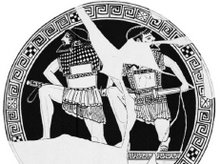
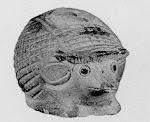
As you can tell by now, I am an advocate of a literal pushing othismos. Because of this I am frustrated by some elements of the pro-othismos arguement as it is currently put forth. I've mentioned these problems previously, but they bear repeating:
Myth 1: "The rim on the aspis evolved as the shield became heavier to allow the weight to be borne on the shoulder as well as the arm."
If you look at the cross-section of an aspis, it is clear that the rim section is far thicker than the core of the face of the shield. Thus a substantial portion of the weight of the shield is in the very rim that they would hypothesize grew to ease the carrying of said weight! A rimless aspis is no heavier than many other single grip shields. Sure, there are images that show the hoplites hanging the shield of their shoulder by the rim, but there are far more showing hoplites with their Corinthian helms pushed back, and I doubt many would support fighting with them in this position. Hanging the aspis by its rim on the shoulder simply takes advantage of the profile, which evolved for a very different purpose.
Myth 2: "Hoplites pushed en masse with their bodies side-on, their left shoulders in the bowl of the aspis, pressing into the back of the man in front."
The illogic of this one becomes apparent if we try to envision a file doing so. Clearly this can only work for the second ranker pushing the first ranker. Beyond that the men's backs are perpendicular to the men behind them! The could push into the right shoulder of the men in front, but that renders weapons play impossible- something the side-on stance is supposed to allow. The other problem is that at anything approaching maximum pushing force for a file, the men would collapse into the bowl of their shields in any case and be square to the foes as they should be.
Myth 3: "Hoplites charge rapidly to add momentum to othismos."
This one is counterintuitive, so I don't blame them for not foreseeing it, but a slow packed advance generates more force, faster than a series of single men impacting like rams. With no need to move to othismos directly from the charge, an extended period can occur of spear fencing prior to a pushing occurring. This eliminates a major difference between the pro- and anti- push crowds.
Tuesday, April 27, 2010


Thursday, March 11, 2010
An image of Othismos
I happened upon an image of othismos as I describe it in my crowd-othismos model: men packed tight belly to back, not pushing side-on. This is an frame from the Discovery Channel's War and Civilization that can be seen on youtube.com. Here we can see the type of packing that must occur. Yes, I know the shields are terrible. You can see that in this environment the overhand grip on the spear will provide a much broader range of motion than even a high underhand grip. You'll also see that at this range the dory is useless for fighting in the front rank against your immediate foe. There is no way to choke up on the shaft far enough to bring an 8' spear to bear on the rank ahead of you. Thus, either the first rank used swords, or fought past the men in front, aiming deeper in the enemy ranks.

Another thing you can see is why I think the shields must overlap right over left, i.e: the man on the left comes up behind the overhanging shield of the man to his right. In the image below, the arrows show a weak point in the shield-wall when overlapped left over right as under the top arrow. The reason this joint gives way is that the portion of shield off to a man's left is easier to push back than the portion to the right. The flange to the left acts as a lever on the hoplites arm, while the right side, if forced back, is pushed into his body.
Now look at the lower arrow and you will see that pushing here only tightens the bond between shields and strengthens the wall, forcing both shields back into the body of the hoplite on the left.


Another thing you can see is why I think the shields must overlap right over left, i.e: the man on the left comes up behind the overhanging shield of the man to his right. In the image below, the arrows show a weak point in the shield-wall when overlapped left over right as under the top arrow. The reason this joint gives way is that the portion of shield off to a man's left is easier to push back than the portion to the right. The flange to the left acts as a lever on the hoplites arm, while the right side, if forced back, is pushed into his body.
Now look at the lower arrow and you will see that pushing here only tightens the bond between shields and strengthens the wall, forcing both shields back into the body of the hoplite on the left.

Thursday, November 26, 2009
The official soundtrack to this blog.
I recently stumbled upon this band on youtube and have to support anyone who sings about Sparta.
Monday, August 31, 2009
Crowd density
I am often asked how and why men enter the close-packed formation needed to conduct the othsimos as I define it. Here is a little video by some reenactors showing how to breach a shield wall. Note the lengths they go to to keep their men packed belly to back. If Hoplites conducted short terminal charges directly into othismos- as opposed to long running charges straight into othismos, which I doubt- then this is how the men packed. Only by packing tight can you transfer your aggregate force. These guys in fact charge too far, since any distance past that needed to achieve their "ramming" speed is wasted. Because close order is more important than velocity, this can be done from very close range after a period of spear fencing as well as from the opeing of combat.
The only way to resist men in this formation is to match it. A dense, close-packed phalanx will simply absorb this. Multiply this interaction along the front of a unit within the phalanx and you can see how it occurred.
The only way to resist men in this formation is to match it. A dense, close-packed phalanx will simply absorb this. Multiply this interaction along the front of a unit within the phalanx and you can see how it occurred.
Tuesday, July 14, 2009
The Harmodios blow
I recently re-read a paper on Greek swordsmanship:
“Footwork in Ancient Greek Swordsmanship”
Brian F. Cook, Metropolitan Museum Journal, Vol. 24 (1989), pp. 57-64
In this paper an overhead strike is discussed. With minor variations it appears as below.

From the paper:
“The so-called "Harmodios blow" studied by Shefton, who coined the useful term by which it is now fairly generally known. This is a slashing movement named for the action of Harmodios in the marble statuary group of the Tyrant-slayers best known from a Roman copy in Naples. The moment most frequently represented is the point of stillness when the sword- hand has been raised head-high with the sword pointing backward over the shoulder in readiness for a downward slash. The blow may be delivered either forehand (Figure 1) or backhand (Figure 2). Philip Lancaster, of the Department of Edged Weapons at the Tower of London, who kindly gave advice on some practical aspects of swordsmanship, pointed out that this movement would be hazardous under normal combat conditions: not only is there some danger that it would put a swordsman off balance, but the action would also leave the sword-arm unprotected and vulnerable. B. B. Shefton had already noted that the sword when raised could not be used for parrying, and that in close combat the blow therefore required careful timing. It would have been particularly dangerous for a Greek hoplite in leaving the armpit exposed above the edge of the cuirass.' A further disadvantage of the Harmodios blow is that it was less effective than a thrust against a well-equipped opponent: it would probably have been resisted even by a padded linen corselet, which would have been vulnerable to a thrust, and would certainly have been ineffective against a metal cuirass." In combat, then, the Harmodios blow can only have been a desperate measure, employed when the vulnerability it imposed was outweighed by a greater danger.”
“Finding no examples of the use of the Harmodios blow before the closing years of the sixth century B.C.,' Shefton connected it with the introduction of the spatulate sword, a more versatile weapon than the straight-edged sword, which is most effective in an underhand stabbing or thrusting movement. It is around the same time that warriors began to be represented in Attic red-figure in a stance that, al- though it soon became conventional, may reflect the kind of simple drill-movement for which no literary evidence survives. The movement is in fact so simple that no specific comment was made by ancient authors: like so many minor details of life, it was too familiar at the time to call for explanation.”
Now the above may all be true, but the Harmodios may not have been so dangerous and unlikely as thought by the authors above. In fact the Harmodios blow might be one of the few strikes available to men who are standing in synaspismos, close order with overlapping shields. If men are in close as I have described previously, shield to shield, then the right arm needs to not only strike in this fashion, but also move in this way to ward the head. I have been experimenting with how one could fight in so close, with only the raised right arm given freedom of movement. The answer is very much like the harmodios blow. Better yet would be to adopt a shorter blade like the Spartans may have done.

An interesting note on swords is that the sword (xiphos) is slung in a sheath high under the left arm, almost like a shoulder-holster for a pistol. I have been told by hoplite reenactors that this makes drawing the sword much easier in the confined space of a fighting phalanx. The manner of hanging the sheath may thus be yet another feature of the panoply designed for fighting in crowded conditions.

“Footwork in Ancient Greek Swordsmanship”
Brian F. Cook, Metropolitan Museum Journal, Vol. 24 (1989), pp. 57-64
In this paper an overhead strike is discussed. With minor variations it appears as below.

From the paper:
“The so-called "Harmodios blow" studied by Shefton, who coined the useful term by which it is now fairly generally known. This is a slashing movement named for the action of Harmodios in the marble statuary group of the Tyrant-slayers best known from a Roman copy in Naples. The moment most frequently represented is the point of stillness when the sword- hand has been raised head-high with the sword pointing backward over the shoulder in readiness for a downward slash. The blow may be delivered either forehand (Figure 1) or backhand (Figure 2). Philip Lancaster, of the Department of Edged Weapons at the Tower of London, who kindly gave advice on some practical aspects of swordsmanship, pointed out that this movement would be hazardous under normal combat conditions: not only is there some danger that it would put a swordsman off balance, but the action would also leave the sword-arm unprotected and vulnerable. B. B. Shefton had already noted that the sword when raised could not be used for parrying, and that in close combat the blow therefore required careful timing. It would have been particularly dangerous for a Greek hoplite in leaving the armpit exposed above the edge of the cuirass.' A further disadvantage of the Harmodios blow is that it was less effective than a thrust against a well-equipped opponent: it would probably have been resisted even by a padded linen corselet, which would have been vulnerable to a thrust, and would certainly have been ineffective against a metal cuirass." In combat, then, the Harmodios blow can only have been a desperate measure, employed when the vulnerability it imposed was outweighed by a greater danger.”
“Finding no examples of the use of the Harmodios blow before the closing years of the sixth century B.C.,' Shefton connected it with the introduction of the spatulate sword, a more versatile weapon than the straight-edged sword, which is most effective in an underhand stabbing or thrusting movement. It is around the same time that warriors began to be represented in Attic red-figure in a stance that, al- though it soon became conventional, may reflect the kind of simple drill-movement for which no literary evidence survives. The movement is in fact so simple that no specific comment was made by ancient authors: like so many minor details of life, it was too familiar at the time to call for explanation.”
Now the above may all be true, but the Harmodios may not have been so dangerous and unlikely as thought by the authors above. In fact the Harmodios blow might be one of the few strikes available to men who are standing in synaspismos, close order with overlapping shields. If men are in close as I have described previously, shield to shield, then the right arm needs to not only strike in this fashion, but also move in this way to ward the head. I have been experimenting with how one could fight in so close, with only the raised right arm given freedom of movement. The answer is very much like the harmodios blow. Better yet would be to adopt a shorter blade like the Spartans may have done.

An interesting note on swords is that the sword (xiphos) is slung in a sheath high under the left arm, almost like a shoulder-holster for a pistol. I have been told by hoplite reenactors that this makes drawing the sword much easier in the confined space of a fighting phalanx. The manner of hanging the sheath may thus be yet another feature of the panoply designed for fighting in crowded conditions.

Tuesday, June 23, 2009
More on crowd pressures
Here is some information from a paper on the pressures generated by crowds:
"Prediction of human crowd pressures"
Accident Analysis and Prevention 38 (2006) 712–722
Ris S.C. Lee, Roger L. Hughes
From the paper we can see the crushing force generated by the crowd at a rock concert over time (the lighter plot is a prediction, ignore it).

The amount of pressure that is fatal to a human varies depending on the duration, since the asphyxiation can occur over time as described above. Very high pressure (6000+ N) can be almost immediately lethal. From the plot above we can see that over the time period of recording from 5-10 minutes, the crowd pressure was almost never below 800N and reached a peak of 1,500N. Since 623-800N were described as a tolerable limit above, and pressures of 1112N lethal, this crowd would have been intolerable and potentially lethal for most of the period. In the concert many people had to be passed out of the crowd and treated by medical professionals.
From another paper:
“Experiments to investigate the level of ‘comfortable’
loads for people against crush barriers”
R.A. Smith*, L.B. Lim
Safety Science 18 (1995) 329-335
This paper had an interesting figure that showed how the pushing force could vary with the degree to which men leaned forward against the man ahead. How this would correlate with forces that hoplite would generate is not really known, but the important thing is to note that the behavior of the men in the crowd can alter the amount of pressure generated. As few as 4-8 men are producing lethal pressures (note the scale of the y-axis is Kilonewtons (1,000N). This data is not even from an especially dense crowd, they can be almost double that density and proportionally more deadly.

The importance of this graph is that it shows that through behavior the amount of force generated by a crowd can be increased. Here simply leaning forward more transmits more force forward. The implication is that through training men can transfer greater force forward more efficiently. This, and other behaviors, is how the system can be tweeked to produce more with training.
"Prediction of human crowd pressures"
Accident Analysis and Prevention 38 (2006) 712–722
Ris S.C. Lee, Roger L. Hughes
In situations where pedestrians are crushed, the density of the crowd is extremely high and the physical movement of pedestrians is almost impossible. When crushing occurs, the high pressures developed within the crowd, which can bend steel barriers or push down brick walls, can be unbearable to some members of the crowd, producing fatalities from asphyxiation while still standing. Generally, the highest pressures are felt by those pedestrians near any barrier that is checking the advance of the crowd. Such pressures will gradually restrict these people from breathing. Each time a breath is exhaled the weight of the load restricts inhalation of the next breath. A slow death caused by suffocation usually follows, unless rescue is immediate. The internal pressure in a crowd on the time scale of a minute or so is thus the critical criterion for determining the likelihood of an accident involving crushing in the crowd. Tests on live subjects conducted by Evans and Hayden (1971) found that the tolerable force was typically 623N for men when pushed against a 100mm wide flat bar. This force increased to typically 800N when the subject was allowed to push against the bar to reduce loading on his rib cage. For women, Evans and Hayden (1971) reported the tolerance levelwas significantly less. Apart from Evans and Hayden (1971), studies on exploring the magnitude of loadings that could cause crush asphyxia found that death was estimated to have occurred 15 seconds after a load of 6227 N and 4–6 min after 1112 N was applied, see Hopkins et al. (1993). It should be noted that loadings of such as these magnitudes are affected by various factors including age, gender and anatomical build.
From the paper we can see the crushing force generated by the crowd at a rock concert over time (the lighter plot is a prediction, ignore it).

The amount of pressure that is fatal to a human varies depending on the duration, since the asphyxiation can occur over time as described above. Very high pressure (6000+ N) can be almost immediately lethal. From the plot above we can see that over the time period of recording from 5-10 minutes, the crowd pressure was almost never below 800N and reached a peak of 1,500N. Since 623-800N were described as a tolerable limit above, and pressures of 1112N lethal, this crowd would have been intolerable and potentially lethal for most of the period. In the concert many people had to be passed out of the crowd and treated by medical professionals.
From another paper:
“Experiments to investigate the level of ‘comfortable’
loads for people against crush barriers”
R.A. Smith*, L.B. Lim
Safety Science 18 (1995) 329-335
The same authors measured loads at several ‘pop concerts’, where at one they measured
instantaneous peak values of up to 4.2 kN/m, 30-second average values up to 1.8 kN/m
and sustained loadings of typically 1.5 kN/m lasting for 10 minutes. Throughout the first half of an act the sustained average load was 0.8 to 1 kN/m. During the concert, people pressed against the barriers and in distress were rescued by being pulled over the barriers and being treated by medical staff.
This paper had an interesting figure that showed how the pushing force could vary with the degree to which men leaned forward against the man ahead. How this would correlate with forces that hoplite would generate is not really known, but the important thing is to note that the behavior of the men in the crowd can alter the amount of pressure generated. As few as 4-8 men are producing lethal pressures (note the scale of the y-axis is Kilonewtons (1,000N). This data is not even from an especially dense crowd, they can be almost double that density and proportionally more deadly.

The importance of this graph is that it shows that through behavior the amount of force generated by a crowd can be increased. Here simply leaning forward more transmits more force forward. The implication is that through training men can transfer greater force forward more efficiently. This, and other behaviors, is how the system can be tweeked to produce more with training.
Modeling hoplite combat
I have, after years of trying off and on, finally gotten in contact with Rob McDermott. If you have not seen his simulation of hoplite combat take a look:
http://www.ddv.co.nz/hoplites/
There are many elements that could be added to raise the realism of the model, but the most important thing is to show how a group behavior, such as phalanx combat, can be self-organized. In this model there is no leader. Each simulated hoplite is an "agent" endowed with a list of very simple responses. The only information they recieve is from their immediate surroundings- from the few men around them acting to push or fight them. One of the biggest problems that those who follow my blog have with my view of phalanx combat is that they don't see how such crowd-wide behavior could be coordinated. Rob's model gives an example, though I would change/add a variety of the details I've exposed in previous posts. I plan to create a model with those elements in the future.
http://www.ddv.co.nz/hoplites/
There are many elements that could be added to raise the realism of the model, but the most important thing is to show how a group behavior, such as phalanx combat, can be self-organized. In this model there is no leader. Each simulated hoplite is an "agent" endowed with a list of very simple responses. The only information they recieve is from their immediate surroundings- from the few men around them acting to push or fight them. One of the biggest problems that those who follow my blog have with my view of phalanx combat is that they don't see how such crowd-wide behavior could be coordinated. Rob's model gives an example, though I would change/add a variety of the details I've exposed in previous posts. I plan to create a model with those elements in the future.
Subscribe to:
Posts (Atom)