Monday, October 25, 2010
Sword use in Othismos
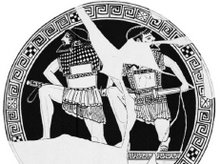
In an earlier post, I wrote that hoplites in the crowd of othismos could strike with short swords over their shields into the necks of their foes in a truly brutal manner. I happened to find an image that shows what this strike would have looked like and where it would have been delivered. Obviously the artist is not depicting othismos, but the arm position of the hoplite and the insertion point, along side the neck into the chest cavity(but on the left), are similar.


Monday, October 4, 2010
The (mis-)understanding of Xenophon's fictional battle of Thymbara
There is a section of Xenophon’s Cyropaedia that is often invoked as evidence against the occurrence of Othismos in hoplite combat and to demonstrate the uselessness of deep files in such pushing matches. It occurs during the fictional battle of Thymbara and the lines seem pretty clear when read in isolation:
Xenophon, Cyropaedia 6.3.20
“And how are the Egyptians drawn up?” asked Cyrus; “for you said ‘with the exception of the Egyptians.’”
“The brigadier-generals drew them up—each one ten thousand men, a hundred square; for this, they said, was their manner of arranging their order of battle at home.
22] “And do you think, Cyrus,” said one of the generals, “that drawn up with lines so shallow we shall be a match for so deep a phalanx?”
“When phalanxes are too deep to reach the enemy with weapons,” answered Cyrus, “how do you think they can either hurt their enemy or help their friends?
23] For my part, I would rather have these1 hoplites who are arranged in columns a hundred deep drawn up ten thousand deep; for in that case we should have very few to fight against. According to the depth that I shall give my line of battle, I think I shall bring the entire line into action and make it everywhere mutually helpful
Xenophon surely knew what he was talking about when it came to hoplite battle and he clearly states the uselessness of such depth. Reading this section alone, I would have a hard time supporting a notion of othismos that brings the force of deep files to bear.
But there is more a bit further on that rarely gets cited along with the above:
Xen. Cyrop. 6.4.17 The infantry that you will fight against, you have fought before—all but the Egyptians; and they are armed and drawn up alike badly; for with those big shields which they have they cannot do anything or see anything; and drawn up a hundred deep, it is clear that they will hinder one another from fighting—all except a few.
Well, here again he reiterates the uselessness of great depth in a phalanx, But…
18] But if they believe that by rushing (ὠθοῦντες) they will rush us off the field, they will first have to sustain the charge of horses and of steel driven upon them by the force of horses; and if any of them should hold his ground, how will he be able to fight at the same time against cavalry and phalanxes and towers? And that he will have to do, for those upon our towers will come to our aid and raining their missiles upon the enemy will drive them to distraction rather than to fighting.
The translator has chosen the word “rush”, but you may recognize the root of Othismos in the actual word used (in bold), thus “push” and “pushed” (or perhaps crowded). Xenophon is clearly stating that the deep phalanx can push his shallow Persian phalanx from the field. The reason he is confident it will not happen is his use of combined arms against it. The first two ranks of the Persians simply have to slow the Egyptian advance while the rear ranks rain down missiles (Interestingly this is a similar mechanic to both the actual Persian tactics and the later Roman Fulcum). He even has set towers on the field to shoot down into the ranks while his cavalry is supposed to hit them in the flank and rear before they can in fact push the Persians from the field.
As he describes it, the battle plays out in just this fashion:
Xenophon, Cyropaedia 7.1.33] Here, then, was a dreadful conflict with spears and lances and swords. The Egyptians, however, had the advantage both in numbers and in weapons; for the spears that they use even unto this day are long and powerful, and their shields cover their bodies much more effectually than corselets and targets, and as they rest against the shoulder they are a help in shoving. So, locking their shields Together, they advanced and showed.
34] And because the Persians had to hold out their little shields clutched in their hands, they were unable to hold the line, but were forced back foot by foot, giving and taking blows,
So here the Persians get the worst of doratismos, but eventually are “pushed” back by a line of locked shields that are better designed for physical pushing, until…
until they came up under cover of the moving towers. When they reached that point, the Egyptians in turn received a volley from the towers; and the forces in the extreme rear would not allow any retreat on the part of either archers or lancers, but with drawn swords they compelled them to shoot and hurl. 35] Then there was a dreadful carnage, an awful din of arms and missiles of every sort, and a great tumult of men, as they called to one another for aid, or exhorted one another, or invoked the gods.
36] At this juncture Cyrus came up in pursuit of1 the part that had been opposed to him; and when he saw that the Persians had been forced from their position, he was grieved; but as he realized that he could in no way check the enemy's progress more quickly than by marching around behind them, he ordered his men to follow him and rode around to the rear. There he fell upon the enemy as they faced the other way and smote them and slew many of them.
The Egyptians are surrounded and ultimately surrender.
To understand this passage, we need to look not only to the context within this book, but to Xenophon’s recent experience. He wrote this book after the Theban 50 rank phalanx at Leuctra and most likely after the 50 rank phalanx at Mantinea as well. These extra deep phalanxes had made resistance in othismos against them futile. In effect, these are the ultimate expression of othismos, but also very vulnerable.
The Thebans had been experimenting with deep phalanxes since at least Delium, where Pagondas formed 25 ranks deep in order to force his way through the Athenian phalanx. They habitually formed in more than 16 ranks and apparently violated a treaty during the Corinthian war designed to force them into a maximum of 16 ranks so as to lengthen the allied battle-line and avoid being flanked by the Spartans. We don’t know the depth at Tegyra, but perhaps the Sacred band did not need extra depth against a foe who erroneously allowed them to break through their battle-line because they assumed the Thebans were attempting to escape the field. They may have had the second phase of Coronea in mind, where Xenophon chided Agiselaos for the bloody battle that ensued when he headed off a retreating Theban formation (probably 25 ranks deep). At that battle they broke through the Spartan center eventually as well, but were spent and routed.
The culmination of all of these experiences with depth was the Theban 50 rank phalanx at Leuktra/ Leuctra. It was not a “column”, as is often stated, any more than a 16 rank taxis was a column, but something like an 80 by 50 rectangular taxis. Hoplites did attempt to engage from marching column on occasion and things did not go well. The 50 rank taxis at Leuctra and Mantinea proved unstoppable, but in no way simply steam-rollered the Spartans from the field. The mechanics of pushing en mass require this to be a slow process and problems of packing within the ranks of each phalanx and moving in unison ensure that there could be a give and take of ground of the type that we read about in accounts of the battles. But a ratcheting advance of the great Theban mass was always likely to win in the end.
Xenophon knew all of this and as an astute general could see the weakness of the extra-deep phalanx to flanking maneuvers and the inability of missile troops to shoot over the deep mass effectively. Thus he does not attempt to do more than slow the Egyptian (Theban) phalanx, while shooting into the mass with missiles both from the rear ranks and down from mobile field fortifications. I’m tempted to think he would have presaged the Spartan tyrant Machanidas’ use of artillery against the phalanx had he not set his book in the Persian past. While he is slowing and distracting them, his cavalry envelops them from the rear and secures victory.
The obvious weakness of the ultra-deep phalanx to flank attack rendered the whole tactic something of a trick that was impossible to carry out against a forewarned and properly armed foe. Already at Mantinea it is possible that the death of Epameinondas was no accident of battle, but indicative of the Spartans hitting the unsupported right flank of the Theban formation. Their inferiority in cavalry compared to the Boeotians rendered outflanking around the left flank unlikely. I generally follow Plutarch’s version of the death of Epameinondas where he is killed by a Spartan sword, but Ephorus, via Diodorus, has him felled by javelins. If there is any truth to the latter it perhaps reflects a Spartan mirror (precedent?) of the thinking of Xenophon’s fictional tactics.
Xenophon, Cyropaedia 6.3.20
“And how are the Egyptians drawn up?” asked Cyrus; “for you said ‘with the exception of the Egyptians.’”
“The brigadier-generals drew them up—each one ten thousand men, a hundred square; for this, they said, was their manner of arranging their order of battle at home.
22] “And do you think, Cyrus,” said one of the generals, “that drawn up with lines so shallow we shall be a match for so deep a phalanx?”
“When phalanxes are too deep to reach the enemy with weapons,” answered Cyrus, “how do you think they can either hurt their enemy or help their friends?
23] For my part, I would rather have these1 hoplites who are arranged in columns a hundred deep drawn up ten thousand deep; for in that case we should have very few to fight against. According to the depth that I shall give my line of battle, I think I shall bring the entire line into action and make it everywhere mutually helpful
Xenophon surely knew what he was talking about when it came to hoplite battle and he clearly states the uselessness of such depth. Reading this section alone, I would have a hard time supporting a notion of othismos that brings the force of deep files to bear.
But there is more a bit further on that rarely gets cited along with the above:
Xen. Cyrop. 6.4.17 The infantry that you will fight against, you have fought before—all but the Egyptians; and they are armed and drawn up alike badly; for with those big shields which they have they cannot do anything or see anything; and drawn up a hundred deep, it is clear that they will hinder one another from fighting—all except a few.
Well, here again he reiterates the uselessness of great depth in a phalanx, But…
18] But if they believe that by rushing (ὠθοῦντες) they will rush us off the field, they will first have to sustain the charge of horses and of steel driven upon them by the force of horses; and if any of them should hold his ground, how will he be able to fight at the same time against cavalry and phalanxes and towers? And that he will have to do, for those upon our towers will come to our aid and raining their missiles upon the enemy will drive them to distraction rather than to fighting.
The translator has chosen the word “rush”, but you may recognize the root of Othismos in the actual word used (in bold), thus “push” and “pushed” (or perhaps crowded). Xenophon is clearly stating that the deep phalanx can push his shallow Persian phalanx from the field. The reason he is confident it will not happen is his use of combined arms against it. The first two ranks of the Persians simply have to slow the Egyptian advance while the rear ranks rain down missiles (Interestingly this is a similar mechanic to both the actual Persian tactics and the later Roman Fulcum). He even has set towers on the field to shoot down into the ranks while his cavalry is supposed to hit them in the flank and rear before they can in fact push the Persians from the field.
As he describes it, the battle plays out in just this fashion:
Xenophon, Cyropaedia 7.1.33] Here, then, was a dreadful conflict with spears and lances and swords. The Egyptians, however, had the advantage both in numbers and in weapons; for the spears that they use even unto this day are long and powerful, and their shields cover their bodies much more effectually than corselets and targets, and as they rest against the shoulder they are a help in shoving. So, locking their shields Together, they advanced and showed.
34] And because the Persians had to hold out their little shields clutched in their hands, they were unable to hold the line, but were forced back foot by foot, giving and taking blows,
So here the Persians get the worst of doratismos, but eventually are “pushed” back by a line of locked shields that are better designed for physical pushing, until…
until they came up under cover of the moving towers. When they reached that point, the Egyptians in turn received a volley from the towers; and the forces in the extreme rear would not allow any retreat on the part of either archers or lancers, but with drawn swords they compelled them to shoot and hurl. 35] Then there was a dreadful carnage, an awful din of arms and missiles of every sort, and a great tumult of men, as they called to one another for aid, or exhorted one another, or invoked the gods.
36] At this juncture Cyrus came up in pursuit of1 the part that had been opposed to him; and when he saw that the Persians had been forced from their position, he was grieved; but as he realized that he could in no way check the enemy's progress more quickly than by marching around behind them, he ordered his men to follow him and rode around to the rear. There he fell upon the enemy as they faced the other way and smote them and slew many of them.
The Egyptians are surrounded and ultimately surrender.
To understand this passage, we need to look not only to the context within this book, but to Xenophon’s recent experience. He wrote this book after the Theban 50 rank phalanx at Leuctra and most likely after the 50 rank phalanx at Mantinea as well. These extra deep phalanxes had made resistance in othismos against them futile. In effect, these are the ultimate expression of othismos, but also very vulnerable.
The Thebans had been experimenting with deep phalanxes since at least Delium, where Pagondas formed 25 ranks deep in order to force his way through the Athenian phalanx. They habitually formed in more than 16 ranks and apparently violated a treaty during the Corinthian war designed to force them into a maximum of 16 ranks so as to lengthen the allied battle-line and avoid being flanked by the Spartans. We don’t know the depth at Tegyra, but perhaps the Sacred band did not need extra depth against a foe who erroneously allowed them to break through their battle-line because they assumed the Thebans were attempting to escape the field. They may have had the second phase of Coronea in mind, where Xenophon chided Agiselaos for the bloody battle that ensued when he headed off a retreating Theban formation (probably 25 ranks deep). At that battle they broke through the Spartan center eventually as well, but were spent and routed.
The culmination of all of these experiences with depth was the Theban 50 rank phalanx at Leuktra/ Leuctra. It was not a “column”, as is often stated, any more than a 16 rank taxis was a column, but something like an 80 by 50 rectangular taxis. Hoplites did attempt to engage from marching column on occasion and things did not go well. The 50 rank taxis at Leuctra and Mantinea proved unstoppable, but in no way simply steam-rollered the Spartans from the field. The mechanics of pushing en mass require this to be a slow process and problems of packing within the ranks of each phalanx and moving in unison ensure that there could be a give and take of ground of the type that we read about in accounts of the battles. But a ratcheting advance of the great Theban mass was always likely to win in the end.
Xenophon knew all of this and as an astute general could see the weakness of the extra-deep phalanx to flanking maneuvers and the inability of missile troops to shoot over the deep mass effectively. Thus he does not attempt to do more than slow the Egyptian (Theban) phalanx, while shooting into the mass with missiles both from the rear ranks and down from mobile field fortifications. I’m tempted to think he would have presaged the Spartan tyrant Machanidas’ use of artillery against the phalanx had he not set his book in the Persian past. While he is slowing and distracting them, his cavalry envelops them from the rear and secures victory.
The obvious weakness of the ultra-deep phalanx to flank attack rendered the whole tactic something of a trick that was impossible to carry out against a forewarned and properly armed foe. Already at Mantinea it is possible that the death of Epameinondas was no accident of battle, but indicative of the Spartans hitting the unsupported right flank of the Theban formation. Their inferiority in cavalry compared to the Boeotians rendered outflanking around the left flank unlikely. I generally follow Plutarch’s version of the death of Epameinondas where he is killed by a Spartan sword, but Ephorus, via Diodorus, has him felled by javelins. If there is any truth to the latter it perhaps reflects a Spartan mirror (precedent?) of the thinking of Xenophon’s fictional tactics.
Monday, September 20, 2010
Helena Schrader and revolting Helots
Recently, a friend of mine, Helena Schrader, who has written many novels set in ancient Sparta with an eye towards dispelling much of the mirage that has been built up around Spartan history, asked me a question on something I posted on her website. I decided to turn her question into a guest spot, giving you both her initial question and my response. Many of you have already followed the link from my site her hers, and I recommend those that have not done so take the opportunity now. She has a new trilogy coming out centered on Leonidas's life.
I mentioned a Helot revolt in 490 BC that may have been the real cause for the Spartan delay that left Athens to face the invasion alone. Her question was as follows:
“What evidence is there for a helot revolt in 490? I have heard it hypothesized that there might have been a helot revolt to explain Sparta's delay in responding to the Athenian plea for assistance against the Persian invasion. But I was not aware of any literary or archeological evidence that supported this thesis. On the contrary, I recently read an account that stressed that no other explanation for the Spartan delay than the one reported by Herodotus (6:106) (waiting for the full moon) was needed. Personally, I have been speculating about another possible reason for the delay - Cleomenes' madness and an internal dispute about who should lead the Spartan army sent to aid Athens. The kings were supposed to command, and Leotychidas does not appear to have been active - or trusted? - as a commander. Cleomenes was going mad - or possibly still in Arkadia. I think internal disagreement about who to put in command might have made it impossible for the Spartans to react promptly, but the desire to keep internal disputes secret made them give the Athenians the excuse of a religious festival. Any way, if you have some strong indicators for the helot revolt, however, I'd be very interested.”
There is one direct reference to a revolt of Helots in 490BC. Plato (Laws 698 D-E) includes the line:
“but when they sent out embassies in every direction to seek aid, all refused, [698e] except the Lacedaemonians; and they were hindered by the war they were then waging against Messene, and possibly by other obstacles, about which we have no information, with the result that they arrived too late by one single day for the battle which took place at Marathon.”
Now, Plato has something of a reputation for paying more attention to his Rhetoric tutors than his history lessons, so of itself his statement is less than compelling. There is a whole suite of circumstantial evidence to back up Plato’s assertion, that in total make an argument that some believe is sufficient to prove a revolt, while others remain unconvinced. Drs. Lazenby and Cawkwell believe in the revolt, while as of the time of his book Sparta and Lakonia: A Regional History, which I draw from for this entry, Dr. Cartledge was agnostic.
First, at Olympia the Spartans dedicated spoils from a war with the Messenians. Pausanias writes that this was dedicated after the second Messenian revolt, which would be the revolt in 465 BC, following the devastation of Sparta by earthquake.
Pausanias, Description of Greece, (5.24.3)
“On the right of the great temple is a Zeus facing the rising of the sun, twelve feet high and dedicated, they say, by the Lacedaemonians, when they entered on a war with the Messenians after their second revolt. On it is an elegiac couplet: “Accept, king, son of Cronus, Olympian Zeus, a lovely image, and have a heart propitious to the Lacedaemonians.”
L. H. Jeffery (JHS, LXVI 1949) showed that the way in which the letters were formed in the dedication could not have been used as late a 465, thus there must have been a “messenian war” before this, but not so early as the first revolt in the early 7th C.
Second, there is a tripod dedicated at Amyclai by Callon to success in a Messenian war. “There are also bronze tripods. The older ones are said to be a tithe of the Messenian war” (Paus. 3.18.7). Callon is thought to have been active at around the turn of the 5th C.
Third, we have a statue dedicated to Zeus, again noted by Pausanias (4.33.2) “The statue of Zeus is the work of Ageladas and was made originally for the Messenian settlers in Naupactus.” But Ageladas worked in the early half of the 5th century and not as late as 460.
Fourth, Anaxilas, an early 5th century Tyrant of Rhegium in southern Italy along with a group of Messenians seized and Zankle in north-eastern Sicily and renamed it Messene in 489-88 BC (E. S. G. Robinson, JHS LXVI 1946).
Fifth, Aristomenes was a Messenian hero from Andania (Paus. 4.14.7). He has been variously dated to the initial subjugation of Messena in the late 8th c, the first revolt some 40 years later, and by the Hellenistic poet Rhianos in his Messeniaka to the late 5th century. A web of evidence including the lives of supposed descendants that has become known as the “Rhianos Hypothesis” supports this later date. For example we are told one of his daughters married Theopompos of Heria, who was an Olympic victor in 284 and 480 BC.
Lastly, there are dedications by ” Messenians” at Delphi in the early 5th century. These and the various instances of the movements of Messenians to colonies could reflect an uprising and its later defeat by the Spartans. Why there should be an uprising at this time is easy to imagine. Surely the Messenians knew by 491 BC that the Persians were coming. One wonders, if the revolt is fact, if it was coup of the Persians or their allies.
There is one last possibility I should mention. Cleomenes I gained the Agiad throne in about 520 BC, and was perhaps one of the most interesting Spartans Kings. As was common with Spartan royalty, he was often at odds with the Spartan legislature. Spartan Kings were severely limited in their power when not on campaign with the army. What they did have were powerful factions within the citizen body politic. More than most, Cleomenes I was ruthless in his politics. His actions led to the famous dethroning and defection of Damaratus to the Persian King’s court.
Later, at a moment of political weakness, his foes attacked, leading him to flee to Arcadia- perhaps by way of Sellasia not Thessaly. There he appears to have been rallying the Arcadians. His modern advocates look to this as a great panhellenic gesture in preparation for facing the Persians. Perhaps I am less generous, but the examples of Damaratus, Lysander, Cleonymus, and his namesake Cleomenes III, all make a direct use of this Arcadian base as a pawn in a power play for Spartan power likely. Remember, this is the man who once famously termed himself an “Achean” in an Athenian temple. If he was rousing Arcadians, is it impossible that there was also some intrigue with Messenians?
Perhaps it was this revolt that prompted the Spartans to bring 7 helots for every Spartan hoplite to the battle of Plataea. Keep your friends close, but your revolting subjects closer…
Further reading:
Sparta and Lakonia: a regional history, 1300-362 BC, Paul Cartledge, Psychology Press, 2002
Cleomenes, G. Cawkwell, Mnemosyne, Fourth Series, Vol. 46 (Nov., 1993)
Discrepancies in olympiad dating and chronological problems of archaic Peloponnesian history, Pamela-Jane Shaw, Volume 166 of Historia. Einzelschriften, Franz Steiner Verlag, 2003
Kleomenes, Marathon, the Helots, and Arkadia, W. P. Wallace, The Journal of Hellenic Studies, Vol. 74 (1954)
I mentioned a Helot revolt in 490 BC that may have been the real cause for the Spartan delay that left Athens to face the invasion alone. Her question was as follows:
“What evidence is there for a helot revolt in 490? I have heard it hypothesized that there might have been a helot revolt to explain Sparta's delay in responding to the Athenian plea for assistance against the Persian invasion. But I was not aware of any literary or archeological evidence that supported this thesis. On the contrary, I recently read an account that stressed that no other explanation for the Spartan delay than the one reported by Herodotus (6:106) (waiting for the full moon) was needed. Personally, I have been speculating about another possible reason for the delay - Cleomenes' madness and an internal dispute about who should lead the Spartan army sent to aid Athens. The kings were supposed to command, and Leotychidas does not appear to have been active - or trusted? - as a commander. Cleomenes was going mad - or possibly still in Arkadia. I think internal disagreement about who to put in command might have made it impossible for the Spartans to react promptly, but the desire to keep internal disputes secret made them give the Athenians the excuse of a religious festival. Any way, if you have some strong indicators for the helot revolt, however, I'd be very interested.”
There is one direct reference to a revolt of Helots in 490BC. Plato (Laws 698 D-E) includes the line:
“but when they sent out embassies in every direction to seek aid, all refused, [698e] except the Lacedaemonians; and they were hindered by the war they were then waging against Messene, and possibly by other obstacles, about which we have no information, with the result that they arrived too late by one single day for the battle which took place at Marathon.”
Now, Plato has something of a reputation for paying more attention to his Rhetoric tutors than his history lessons, so of itself his statement is less than compelling. There is a whole suite of circumstantial evidence to back up Plato’s assertion, that in total make an argument that some believe is sufficient to prove a revolt, while others remain unconvinced. Drs. Lazenby and Cawkwell believe in the revolt, while as of the time of his book Sparta and Lakonia: A Regional History, which I draw from for this entry, Dr. Cartledge was agnostic.
First, at Olympia the Spartans dedicated spoils from a war with the Messenians. Pausanias writes that this was dedicated after the second Messenian revolt, which would be the revolt in 465 BC, following the devastation of Sparta by earthquake.
Pausanias, Description of Greece, (5.24.3)
“On the right of the great temple is a Zeus facing the rising of the sun, twelve feet high and dedicated, they say, by the Lacedaemonians, when they entered on a war with the Messenians after their second revolt. On it is an elegiac couplet: “Accept, king, son of Cronus, Olympian Zeus, a lovely image, and have a heart propitious to the Lacedaemonians.”
L. H. Jeffery (JHS, LXVI 1949) showed that the way in which the letters were formed in the dedication could not have been used as late a 465, thus there must have been a “messenian war” before this, but not so early as the first revolt in the early 7th C.
Second, there is a tripod dedicated at Amyclai by Callon to success in a Messenian war. “There are also bronze tripods. The older ones are said to be a tithe of the Messenian war” (Paus. 3.18.7). Callon is thought to have been active at around the turn of the 5th C.
Third, we have a statue dedicated to Zeus, again noted by Pausanias (4.33.2) “The statue of Zeus is the work of Ageladas and was made originally for the Messenian settlers in Naupactus.” But Ageladas worked in the early half of the 5th century and not as late as 460.
Fourth, Anaxilas, an early 5th century Tyrant of Rhegium in southern Italy along with a group of Messenians seized and Zankle in north-eastern Sicily and renamed it Messene in 489-88 BC (E. S. G. Robinson, JHS LXVI 1946).
Fifth, Aristomenes was a Messenian hero from Andania (Paus. 4.14.7). He has been variously dated to the initial subjugation of Messena in the late 8th c, the first revolt some 40 years later, and by the Hellenistic poet Rhianos in his Messeniaka to the late 5th century. A web of evidence including the lives of supposed descendants that has become known as the “Rhianos Hypothesis” supports this later date. For example we are told one of his daughters married Theopompos of Heria, who was an Olympic victor in 284 and 480 BC.
Lastly, there are dedications by ” Messenians” at Delphi in the early 5th century. These and the various instances of the movements of Messenians to colonies could reflect an uprising and its later defeat by the Spartans. Why there should be an uprising at this time is easy to imagine. Surely the Messenians knew by 491 BC that the Persians were coming. One wonders, if the revolt is fact, if it was coup of the Persians or their allies.
There is one last possibility I should mention. Cleomenes I gained the Agiad throne in about 520 BC, and was perhaps one of the most interesting Spartans Kings. As was common with Spartan royalty, he was often at odds with the Spartan legislature. Spartan Kings were severely limited in their power when not on campaign with the army. What they did have were powerful factions within the citizen body politic. More than most, Cleomenes I was ruthless in his politics. His actions led to the famous dethroning and defection of Damaratus to the Persian King’s court.
Later, at a moment of political weakness, his foes attacked, leading him to flee to Arcadia- perhaps by way of Sellasia not Thessaly. There he appears to have been rallying the Arcadians. His modern advocates look to this as a great panhellenic gesture in preparation for facing the Persians. Perhaps I am less generous, but the examples of Damaratus, Lysander, Cleonymus, and his namesake Cleomenes III, all make a direct use of this Arcadian base as a pawn in a power play for Spartan power likely. Remember, this is the man who once famously termed himself an “Achean” in an Athenian temple. If he was rousing Arcadians, is it impossible that there was also some intrigue with Messenians?
Perhaps it was this revolt that prompted the Spartans to bring 7 helots for every Spartan hoplite to the battle of Plataea. Keep your friends close, but your revolting subjects closer…
Further reading:
Sparta and Lakonia: a regional history, 1300-362 BC, Paul Cartledge, Psychology Press, 2002
Cleomenes, G. Cawkwell, Mnemosyne, Fourth Series, Vol. 46 (Nov., 1993)
Discrepancies in olympiad dating and chronological problems of archaic Peloponnesian history, Pamela-Jane Shaw, Volume 166 of Historia. Einzelschriften, Franz Steiner Verlag, 2003
Kleomenes, Marathon, the Helots, and Arkadia, W. P. Wallace, The Journal of Hellenic Studies, Vol. 74 (1954)
Wednesday, July 21, 2010
A Quantitative Evaluation of Hoplite Combat
For years now I have advocated that those interested in hoplite combat should make greater use of reenactors who put a great deal of time and money into acquiring an authentic hoplite panoply. Many groups of reenactors exist all over the globe, and I know memeber of many of them. In discussing various hoplte topics with them, one thing is clear: if you ask any two reenactors the way hoplites did something, you'll get three opinions. The fundamental problem is that all the conclusions they draw are based on anectdotal evidence. This does not make any of them wrong, even when they disagree, but the lack of standardization makes comparing between them almost impossible. Often we can't know exaclty why they had different experiences.
It has long been a goal of mine to assist groups of reenactors in generating quantitative data on various aspects of hoplite combat. This would be hard data, numbers that we could crunch to provide a true comparison between individuals and between hoplite reenactment groups.
There are many elements of hoplite combat that need to be tested, but my main concern is the safety of reenactors, thus no othismos for the time being. I've attached an image that could serve as a first attempt at a standardized test for hoplite groups. This set-up is a basic stabbing test. The data will give us a rate of striking for a hoplite in formation. I think this rate can be fairly well correlated to the offensive potential of hoplites engaged in doratismos. By altering the size of the target and requiring more accuracy, we can simulate strikes that would "kill" or wound. Because we are simulating group combat, at least three men side by side are needed to create a hoplite bounded on both flanks by other men. For our purposes only the central hoplite can be have his strike number recorded, for only he in flanked by others.

Within this basic set-up, we can alter a variety of variables:
Duration of test period: stamina
Size of target (moving target): accuracy
Grip type: underhand or overhand
Number of ranks in the phalanx
Lateral inter-hoplite spacing
Fore-and-aft spacing
Number of ranks stabbing forward at targets (1, 2 or 3)
Striking while under physical pressure from rear ranks of various length files
Change focus to record the striking rate of the second or third man in the file
Here is a second simple test. This one is to quantify the loss of cohesion that we all know occurs as a phalanx advances rapidly in close order. You simply measure the distance between a point on any adjacent hoplites in rank or file- I suggest the left foot. Then you have the formation advance at whatever speed and in whatever formation you wish to test. The men are made to stop at some signal, a horn or simple shout is preferable to a demarkation so that it is harder to predict. Then you simply remeasure the distances between hoplites. The deviation between each pair from their original spacing is a measure of a loss of order. From there you can ask if they became tighter or looser. The test can be repeated varying the with different starting formations, individual advancing posture, distance, and speed of advance, etc.

I've got a few groups signed on for some testing and welcome any who seek to join. Whatever we are able to do I will run appropriate statistics on and we'll try to publish someplace so that we can all refer to it. Obviously a large number of individuals being tested is good to control for variation between hoplites, but I'd like to get multiple groups involved as well if possible. I welcome discussion on this experiment and hopefully we can plan other experiments as well.
It has long been a goal of mine to assist groups of reenactors in generating quantitative data on various aspects of hoplite combat. This would be hard data, numbers that we could crunch to provide a true comparison between individuals and between hoplite reenactment groups.
There are many elements of hoplite combat that need to be tested, but my main concern is the safety of reenactors, thus no othismos for the time being. I've attached an image that could serve as a first attempt at a standardized test for hoplite groups. This set-up is a basic stabbing test. The data will give us a rate of striking for a hoplite in formation. I think this rate can be fairly well correlated to the offensive potential of hoplites engaged in doratismos. By altering the size of the target and requiring more accuracy, we can simulate strikes that would "kill" or wound. Because we are simulating group combat, at least three men side by side are needed to create a hoplite bounded on both flanks by other men. For our purposes only the central hoplite can be have his strike number recorded, for only he in flanked by others.

Within this basic set-up, we can alter a variety of variables:
Duration of test period: stamina
Size of target (moving target): accuracy
Grip type: underhand or overhand
Number of ranks in the phalanx
Lateral inter-hoplite spacing
Fore-and-aft spacing
Number of ranks stabbing forward at targets (1, 2 or 3)
Striking while under physical pressure from rear ranks of various length files
Change focus to record the striking rate of the second or third man in the file
Here is a second simple test. This one is to quantify the loss of cohesion that we all know occurs as a phalanx advances rapidly in close order. You simply measure the distance between a point on any adjacent hoplites in rank or file- I suggest the left foot. Then you have the formation advance at whatever speed and in whatever formation you wish to test. The men are made to stop at some signal, a horn or simple shout is preferable to a demarkation so that it is harder to predict. Then you simply remeasure the distances between hoplites. The deviation between each pair from their original spacing is a measure of a loss of order. From there you can ask if they became tighter or looser. The test can be repeated varying the with different starting formations, individual advancing posture, distance, and speed of advance, etc.

I've got a few groups signed on for some testing and welcome any who seek to join. Whatever we are able to do I will run appropriate statistics on and we'll try to publish someplace so that we can all refer to it. Obviously a large number of individuals being tested is good to control for variation between hoplites, but I'd like to get multiple groups involved as well if possible. I welcome discussion on this experiment and hopefully we can plan other experiments as well.
Monday, June 7, 2010
Schwartz and Mathew on Hoplite Combat
I just received Adam Schwartz's "Reinstating the Hoplite: Arms, Armour and Phalanx Fighting in Archaic and Classical Greece". It is an excellent resource, and a good rebuttal to many of the weak points of Hans Van Wees "Greek Warfare: Myths and Realities." Unfortunately, he passes over some of Van Wees better ideas and propagates mechanics for othismos which you should recognize as flawed if you've read through my previous posts. There is not all that much new in the book, and some of the the newer elements are subject to logical flaws, but as a review it is an excellent resource if you can afford to add it to your shelf.
The book is most useful to me in that he provides passages from German works that have been opaque to me until now. One of these is a book by Franz (2002) that actually discusses crowd behavior, though once again confusing the manner in which force is generated in crowds. Still, I would have cited him in my 2007 paper had I known he even broached the topic.
I'll do an in-depth review of this book at some point. Perhaps comparing where I agree with him and where Van Wees and Goldsworthy are correct.
The second work that has come into my possession is a paper by Chris Mathew, "When Push Comes to Shove: What was the Othismos of Hoplite Combat?" I have corresponded with Chris in the past, a hoplite reenactor and a very nice fellow. I was very pleased to see a reenactor working for his Ph.D. and looked forward to his input into the debate. Unfortunately I cannot agree with most of his views on hoplite battle. His main assertion, that hoplites fought with the dory using what I and others have termed the "high underhand" grip, is surely incorrect. As with the book above, I will try to do a full review of this paper in the near future. I think his main problem is that he was working within the paradigm of the "charge directly into othismos" crowd. The formations he describes are well suited to defeating such a charge, but taken out of that context can be shown to be quite ill suited to hoplite combat.
The book is most useful to me in that he provides passages from German works that have been opaque to me until now. One of these is a book by Franz (2002) that actually discusses crowd behavior, though once again confusing the manner in which force is generated in crowds. Still, I would have cited him in my 2007 paper had I known he even broached the topic.
I'll do an in-depth review of this book at some point. Perhaps comparing where I agree with him and where Van Wees and Goldsworthy are correct.
The second work that has come into my possession is a paper by Chris Mathew, "When Push Comes to Shove: What was the Othismos of Hoplite Combat?" I have corresponded with Chris in the past, a hoplite reenactor and a very nice fellow. I was very pleased to see a reenactor working for his Ph.D. and looked forward to his input into the debate. Unfortunately I cannot agree with most of his views on hoplite battle. His main assertion, that hoplites fought with the dory using what I and others have termed the "high underhand" grip, is surely incorrect. As with the book above, I will try to do a full review of this paper in the near future. I think his main problem is that he was working within the paradigm of the "charge directly into othismos" crowd. The formations he describes are well suited to defeating such a charge, but taken out of that context can be shown to be quite ill suited to hoplite combat.
Friday, May 21, 2010
Syssition to Phitidion
Change has come to Hollow Lakedaimon. You will note that we are no longer the online syssition, we have laconized to the online Phitidion. Phitidia is what the common messes were called at Sparta, so I have broken down and made the change though I do like the sound of syssition much more. Here's what Plutarch had to say:
Plutarch, Life of Lycurgus chapter 12:
(1) As for the public messes, the Cretans call them andreia, but the Lacedaemonians phitidia, either because they are conducive to friendship [philia] and friendliness, or because they accustom men to simplicity and thrift, for which their word is pheidô. But it is quite possible, as some say, that the first letter of the word phitidia has been added to it, making phitidia out of editia, which refers merely to meals and eating. (2) They met in companies of fifteen, a few more or less, and each one of the mess-mates contributed monthly a bushel [medimnos] of barley-meal, eight gallons of wine, five pounds [mnai] of cheese, two and a half pounds of cheese, two and a half pounds of figs, and in addition to this, a very small sum of money for such relishes as flesh and fish. Besides this, whenever any one made a sacrifice of first fruits or brought home game from the hunt, he sent a portion to his mess. For whenever any one was made late by a sacrifice or the chase, he was allowed to dine at home, but the rest had to be at the mess. (3) For a long time this custom of eating at common mess-tables was rigidly observed. For instance, when King Agis, on returning from an expedition in which he had been victorious over the Athenians, wished to dine at home with his wife, and sent for his rations, the Polemarchs refused to send them to him; and when on the following day his anger led him to omit the customary sacrifice, they laid a fine on him.
(4) Boys also used to come to these public messes, as if they were attending schools of sobriety; there they would listen to political discussions and see instructive models of free behavior [eleutheria]. There they themselves also became accustomed to sport and jest without scurrility, and to endure jesting without displeasure. Indeed, it seems to have been especially characteristic of a Spartan to endure jesting; but if anyone could not bear up under it, he had only to ask it, and the jester ceased. As each one came in, the eldest of the company pointed to the door and said to him, "Through that door no word goes forth outside." (5) And they say that a candidate for membership in one of these messes underwent the following ordeal. Each of the mess-mates took in his hand a bit of soft bread, and when a servant came along with a bowl upon his head, then they cast it into this without a word, like a ballot, leaving it just as it was if he approved of the candidate, but if he disapproved, squeezing it tight in his hand first. (6) For the flattened piece of bread had the force of a perforated, or negative, ballot. And if one such is found in the bowl, the candidate is not admitted to the mess, because they wish all its members to be congenial. The candidate thus rejected is said to have been 'kaddished' [kekaddisthai], for kaddichos is the name of the bowl into which they cast the pieces of bread. (7) Of their dishes, the black broth [zomos] is held in the highest esteem, so that the elderly men do not even ask for a bit of meat, but leave it for the young men, while they themselves have the broth poured out for their meals. And it is said that one of the kings of Pontos actually bought a Spartan cook for the sake of having this broth, and then, when he tasted it, disliked it; whereupon the cook said, 'O King, those who relish this broth must first have bathed in the River Eurotas.' After drinking moderately, they go off home without a torch; for they are not allowed to walk with a light, either on this or any other occasion, that they may accustom themselves to marching boldly and without fear in the darkness of night. Such, then, is the fashion of their common messes.
Plutarch, Life of Lycurgus chapter 12:
(1) As for the public messes, the Cretans call them andreia, but the Lacedaemonians phitidia, either because they are conducive to friendship [philia] and friendliness, or because they accustom men to simplicity and thrift, for which their word is pheidô. But it is quite possible, as some say, that the first letter of the word phitidia has been added to it, making phitidia out of editia, which refers merely to meals and eating. (2) They met in companies of fifteen, a few more or less, and each one of the mess-mates contributed monthly a bushel [medimnos] of barley-meal, eight gallons of wine, five pounds [mnai] of cheese, two and a half pounds of cheese, two and a half pounds of figs, and in addition to this, a very small sum of money for such relishes as flesh and fish. Besides this, whenever any one made a sacrifice of first fruits or brought home game from the hunt, he sent a portion to his mess. For whenever any one was made late by a sacrifice or the chase, he was allowed to dine at home, but the rest had to be at the mess. (3) For a long time this custom of eating at common mess-tables was rigidly observed. For instance, when King Agis, on returning from an expedition in which he had been victorious over the Athenians, wished to dine at home with his wife, and sent for his rations, the Polemarchs refused to send them to him; and when on the following day his anger led him to omit the customary sacrifice, they laid a fine on him.
(4) Boys also used to come to these public messes, as if they were attending schools of sobriety; there they would listen to political discussions and see instructive models of free behavior [eleutheria]. There they themselves also became accustomed to sport and jest without scurrility, and to endure jesting without displeasure. Indeed, it seems to have been especially characteristic of a Spartan to endure jesting; but if anyone could not bear up under it, he had only to ask it, and the jester ceased. As each one came in, the eldest of the company pointed to the door and said to him, "Through that door no word goes forth outside." (5) And they say that a candidate for membership in one of these messes underwent the following ordeal. Each of the mess-mates took in his hand a bit of soft bread, and when a servant came along with a bowl upon his head, then they cast it into this without a word, like a ballot, leaving it just as it was if he approved of the candidate, but if he disapproved, squeezing it tight in his hand first. (6) For the flattened piece of bread had the force of a perforated, or negative, ballot. And if one such is found in the bowl, the candidate is not admitted to the mess, because they wish all its members to be congenial. The candidate thus rejected is said to have been 'kaddished' [kekaddisthai], for kaddichos is the name of the bowl into which they cast the pieces of bread. (7) Of their dishes, the black broth [zomos] is held in the highest esteem, so that the elderly men do not even ask for a bit of meat, but leave it for the young men, while they themselves have the broth poured out for their meals. And it is said that one of the kings of Pontos actually bought a Spartan cook for the sake of having this broth, and then, when he tasted it, disliked it; whereupon the cook said, 'O King, those who relish this broth must first have bathed in the River Eurotas.' After drinking moderately, they go off home without a torch; for they are not allowed to walk with a light, either on this or any other occasion, that they may accustom themselves to marching boldly and without fear in the darkness of night. Such, then, is the fashion of their common messes.
Tuesday, May 4, 2010
Unfounded Objections to Othismos
The biggest objections to othismos dissapear when you accept my definition of othismos only occuring at crowd-like densities and understand how crowds push:
"Battles were long, men can't push that long."
The crowd cannot do anything fast. As soon as it starts to advance it begins to lose cohesion. Once this occurs it cannot transfer force through the ranks effectively. That is not to say "pushing" stops, but by my definition, the type of pushing done by the first few ranks with not transfer of force from deep in the file is not true "othismos", but the same shield bashing and pushing seen in a clash of any group of close-in fighters such as during Roman battles. For the most part in the Crowd-Othismos men are simply standing and leaning. It is exhausting, perhaps moreso mentally than physically, but no more than active weapons duelling. The phalanx does not advance like a steam roller, but like a ratchet, with perdiodic loosening and tightening of the ranks. When a rapid advance does occur, like it must have as one side gave way, it was only the front ranks pushing and even they were doing more "herding" like we see with riot police and crowds, than pushing in the sense of othismos.
An advance in true othismos can only occur through shuffling steps until one side gives way. As they begin to rout, they reduce the pressure on their foes that the othismos-crowd requires.
"Men can't fight and push"
When authors envisioned men bent over like rugby scrummers I could understand this objection. In the Crowd-Othismos, men are standing upright, and but for the extreme close range, their right arms are free to do whatever they wish with them. Obviously at this range you cannot use your dory against the man ahead of you, but the dory is some 8' long, not an Iklwa. It could not be used at any range approaching shield on shield contact. Swords, broken spears, fists, foot-stomps/hooks and teeth would be the order of the day.
"Twelve ranks of Spartans could not resist 50 ranks of Thebans for more than a few moments and yet we know that this phase of battle lasted for some time, with the Spartans even gaining ground to pick up their fallen King."
Not a problem when we understand that coordination of the crowds movements is what adds force in the othismos. There is only so much coordination you can get out of a file of 50 men. Even with a deep phalanx you probably can't get much more than 8-12 ranks perfectly coordinated. Thus, each side produces a forward thrust of about the same size at any given moment. As we wrote above, the depth acts like a wall behind your back. If you are pushed back, it forces all your ranks to tighten and become de facto coordinated to resist being moved. Twelve ranks of Spartans could push back the Thebans, but at a great disadvantage. The figurative "uphill battle" could only end one way.
I'll note that my distinction of pushing at different densities, with othimos only occurring at the tightest packed is not something that the Greeks would have made. They only speak of battles coming down to pushing, they did not disect the process and probably did not undertand it any better than a college kid rushing a stage at a rock concert. To them the whole process was one event.
"Battles were long, men can't push that long."
The crowd cannot do anything fast. As soon as it starts to advance it begins to lose cohesion. Once this occurs it cannot transfer force through the ranks effectively. That is not to say "pushing" stops, but by my definition, the type of pushing done by the first few ranks with not transfer of force from deep in the file is not true "othismos", but the same shield bashing and pushing seen in a clash of any group of close-in fighters such as during Roman battles. For the most part in the Crowd-Othismos men are simply standing and leaning. It is exhausting, perhaps moreso mentally than physically, but no more than active weapons duelling. The phalanx does not advance like a steam roller, but like a ratchet, with perdiodic loosening and tightening of the ranks. When a rapid advance does occur, like it must have as one side gave way, it was only the front ranks pushing and even they were doing more "herding" like we see with riot police and crowds, than pushing in the sense of othismos.
An advance in true othismos can only occur through shuffling steps until one side gives way. As they begin to rout, they reduce the pressure on their foes that the othismos-crowd requires.
"Men can't fight and push"
When authors envisioned men bent over like rugby scrummers I could understand this objection. In the Crowd-Othismos, men are standing upright, and but for the extreme close range, their right arms are free to do whatever they wish with them. Obviously at this range you cannot use your dory against the man ahead of you, but the dory is some 8' long, not an Iklwa. It could not be used at any range approaching shield on shield contact. Swords, broken spears, fists, foot-stomps/hooks and teeth would be the order of the day.
"Twelve ranks of Spartans could not resist 50 ranks of Thebans for more than a few moments and yet we know that this phase of battle lasted for some time, with the Spartans even gaining ground to pick up their fallen King."
Not a problem when we understand that coordination of the crowds movements is what adds force in the othismos. There is only so much coordination you can get out of a file of 50 men. Even with a deep phalanx you probably can't get much more than 8-12 ranks perfectly coordinated. Thus, each side produces a forward thrust of about the same size at any given moment. As we wrote above, the depth acts like a wall behind your back. If you are pushed back, it forces all your ranks to tighten and become de facto coordinated to resist being moved. Twelve ranks of Spartans could push back the Thebans, but at a great disadvantage. The figurative "uphill battle" could only end one way.
I'll note that my distinction of pushing at different densities, with othimos only occurring at the tightest packed is not something that the Greeks would have made. They only speak of battles coming down to pushing, they did not disect the process and probably did not undertand it any better than a college kid rushing a stage at a rock concert. To them the whole process was one event.
Subscribe to:
Posts (Atom)